
Most organizations are not struggling because they lack data. They are struggling because their data is still too fragmented, too inconsistent, and too disconnected from the business.
That was my biggest takeaway from Microsoft's advisory, Executive strategy for unifying your data.
What stood out to me is that Microsoft gets an important point right: this is not just a data platform discussion. It is a leadership issue. It is an operating model issue. And increasingly, it is an AI readiness issue.
I have seen this firsthand. In many environments, the problem is not that the organization lacks tools. It is that data lives in too many places, ownership is unclear, governance is uneven, and teams are still spending too much time figuring out which version of the truth they should trust.
That is not a tooling gap. That is a strategy gap.
Fragmented data keeps showing up as business friction
You can invest in cloud, modernize infrastructure, improve security, and deploy new analytics platforms, but if your data estate is still fragmented, you are going to keep running into the same problems.
Reporting takes longer than it should. Decision-making slows down.
Governance becomes reactive.
And AI initiatives look more mature in PowerPoint than they do in production. That is why I think Microsoft's advisory is worth paying attention to.
It puts the focus where it belongs: organizational readiness, architecture, governance, security, and operational standards. In other words, the things that actually determine whether a data strategy works in the real world.
Data unification is a leadership problem first
From my perspective, this is where too many organizations still get it wrong. They treat data unification as a platform project when it really needs to be treated as a business priority.
They focus on technology selection before they establish ownership, accountability, and standards. Then they wonder why complexity follows them into the new environment.
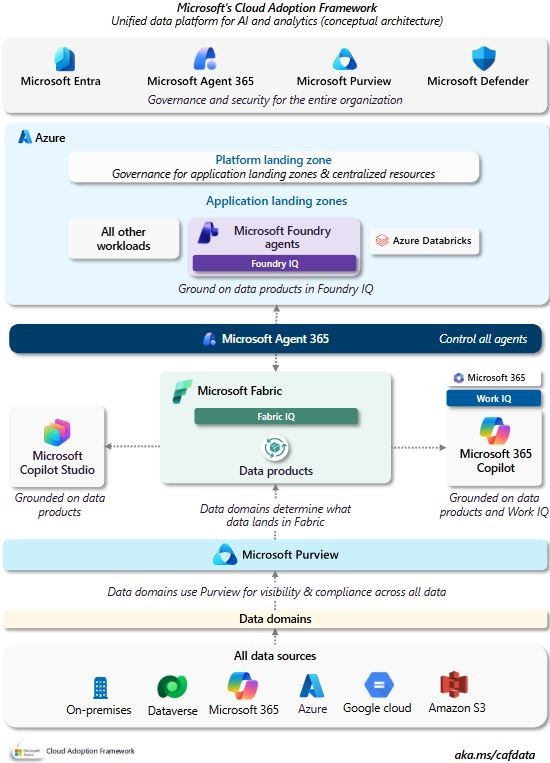
A modern data platform can absolutely help. Microsoft Fabric, OneLake, Purview, and related Azure services can provide a stronger foundation for access, governance, analytics, and AI. But technology by itself does not create trust. It does not create discipline. And it definitely does not create alignment.
People do. Process does. Leadership does.
AI will expose weak data practices quickly
That becomes even more important now that everyone is racing toward AI.
A lot of organizations want the benefits of AI without doing the harder foundational work first. But AI will expose weak data practices very quickly. If your data is inconsistent, poorly governed, or scattered across silos, AI is not going to fix that. It is going to amplify it.
Retrieval systems need trusted sources. Agents need permission boundaries. Analytics teams need definitions that hold up across business units. Security teams need visibility into where sensitive data lives and who can use it.
Without that foundation, AI becomes another layer of abstraction over the same old uncertainty.
What leaders should ask before buying another tool
Microsoft's framework points to the right sequence: readiness, architecture, governance and security baselines, then operational standards. I would translate that into a few practical questions.
- Who owns each critical data domain, and who is accountable for its quality?
- Which data products are most important to business decisions, analytics, and AI?
- Where are standards inconsistent across teams, platforms, and reporting layers?
- How are access, classification, retention, and lineage governed across the estate?
- What is the operating model for publishing, securing, and retiring data products?
These questions are not as flashy as a platform demo. But they are usually the difference between a data strategy that survives contact with the business and one that becomes another expensive integration program.
The goal is trusted data, not just centralized data
That is why I see data unification as much more than an analytics initiative. It is really about building a foundation the business can trust. One that supports better decisions, stronger governance, and more responsible innovation.
To me, that is the real value in Microsoft's message.
The organizations that will get the most from data and AI are not the ones with the most tools. They are the ones that get serious about alignment across business, IT, cloud, and security.
That is what turns data into a strategic asset instead of a constant source of friction.
Curious how others are seeing this in their own environments. Is data unification being treated as a real business priority, or is it still mostly being framed as a technology project?
Reference
Microsoft Cloud Adoption Framework - Executive strategy for unifying your data
Topics: Data strategy, data governance, AI readiness, digital transformation, cloud computing, data management, business strategy, Microsoft Fabric, Microsoft Purview, and enterprise architecture.
Related reading
Don't Start With Agents. Start With the Simplest Architecture That Works.
A practical Microsoft AI stack decision framework for engineers: use code, RAG, SaaS agents, or custom agents based on the real requirements, not the hype.
Microsoft's Real AI Power Move Is the Stack
Microsoft's Build 2026 AI announcements point beyond models toward enterprise tuning, inference economics, data centers, and full-stack AI strategy.
AI Agents Need Managers Too
Why project management, agile delivery, and operating discipline become more important as AI agents enter real workflows.