For years, I kept telling myself I would eventually study for the PMP.
Like a lot of people in technology, I had a reason ready. Too busy. Too many other priorities. Too much real-world experience to stop and formalize something I was already doing in practice.
Lately, though, I have started to see it differently.
One of the reasons I finally decided to stop putting it off is that I think project management becomes even more valuable in the age of AI.
Especially in agile environments.
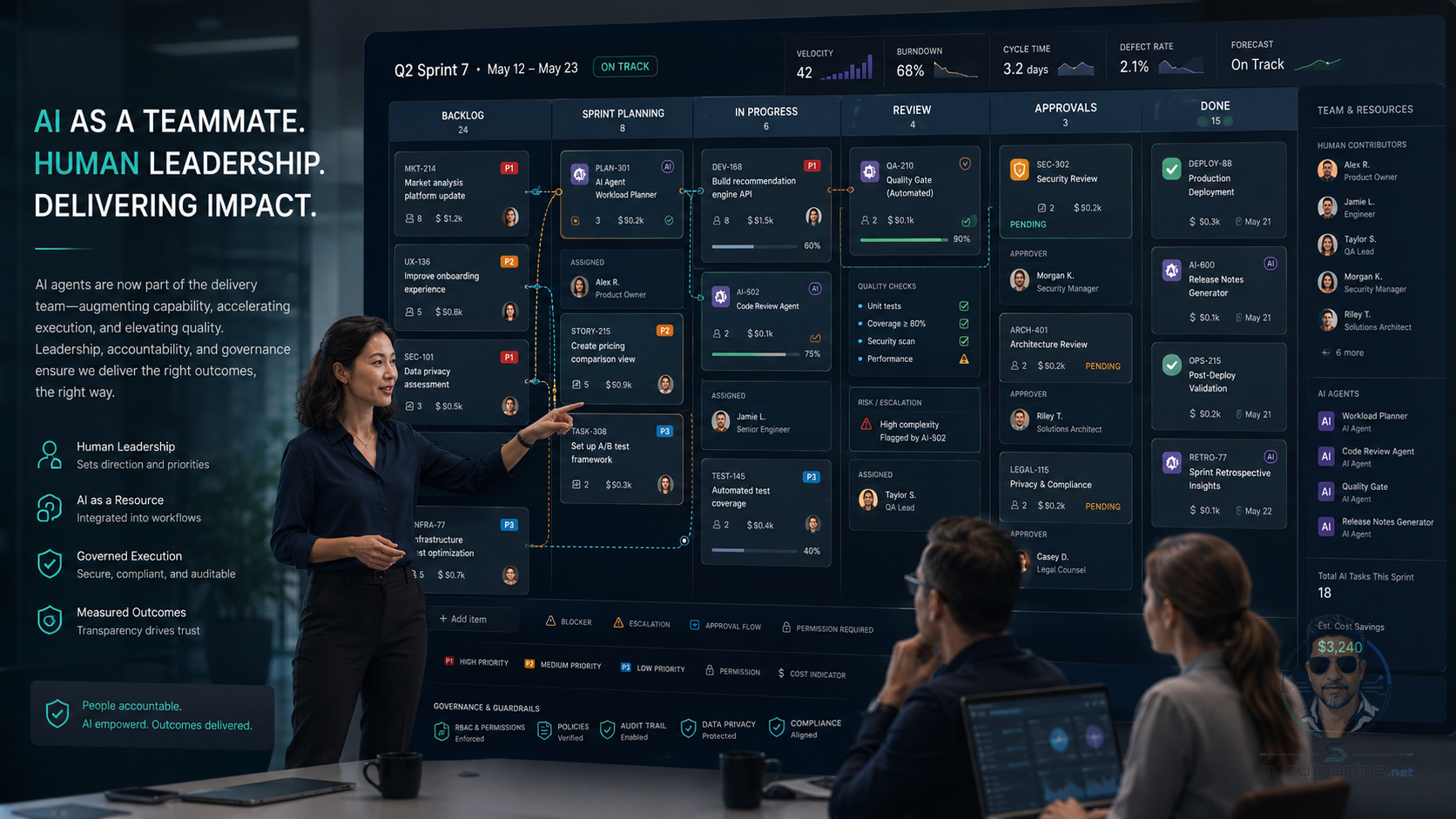
We are moving into a world where AI agents can increasingly function like resources inside a workflow. They can draft, summarize, research, analyze, coordinate, and accelerate delivery in ways that would have sounded much more futuristic just a few years ago. That shift is exciting. It is also creating a new management problem hiding inside the productivity story.
Because once AI agents start doing meaningful work inside a process, someone still has to manage the work.
The work still needs management
This is the part I think people sometimes skip over in the current AI conversation.
There is a lot of attention on what agents can do:
- write code
- generate documentation
- produce summaries
- route tasks
- analyze data
- complete multi-step workflows
All of that matters.
But once that work enters a real delivery environment, the questions become very familiar:
- What exactly is in scope?
- What comes first?
- What depends on what?
- Who approves the output?
- What happens when the agent gets it wrong?
- Who owns quality?
- Who controls permissions?
- How do you keep costs from quietly expanding?
- When does the work need a human in the loop?
- Who is accountable when a workflow fails?
Those are management questions.
The presence of AI does not remove them. In some ways, it multiplies them.
Agents are productive, but they are not self-governing
One of the easiest mistakes to make with AI is to confuse execution with management.
An AI agent may be able to perform a task very quickly. That does not mean it understands business context, delivery tradeoffs, organizational politics, stakeholder expectations, or the hidden costs of getting something almost right.
That gap matters.
In traditional project work, a strong project manager or delivery lead helps organize uncertainty. They clarify goals, sequence work, reduce ambiguity, manage dependencies, communicate risks, and keep execution aligned with outcomes.
That role does not disappear when some contributors become digital.
It becomes more important.
Because agents introduce a new kind of team complexity. They are fast, scalable, and increasingly capable, but they are also:
- probabilistic
- context-sensitive
- permission-dependent
- error-prone in uneven ways
- capable of producing output that looks more confident than it really is
That means the work around them needs structure.
Agile becomes more interesting, not less
I think this becomes especially important in agile environments.
Agile already assumes change, iteration, and continuous reprioritization. It works well when teams can move quickly while staying aligned around backlog, sprint goals, feedback, and delivery cadence.
Now imagine adding AI agents into that picture as part of the execution layer.
Suddenly, new questions emerge:
- Can an agent own a backlog task?
- Can it participate in a workflow the way a human contributor does?
- How should story sizing change when part of the work is accelerated by AI?
- What does capacity planning look like when some resources are nonhuman and elastic?
- How do you estimate effort when the output is faster but the validation burden is higher?
- What happens to definition of done when AI contributed materially to the result?
Those are not theoretical questions for very long.
They are delivery questions.
And to me, that is one reason project management starts to look more strategically valuable, not less.
The operating model matters
This is where I think a lot of organizations will struggle.
They will adopt AI capabilities before they update the management model around them.
That usually creates one of two bad outcomes.
The first is chaos dressed up as innovation. Teams move fast, automate aggressively, and create the appearance of acceleration, but underneath it all there is weak ownership, fuzzy accountability, poor quality control, and rising operational risk.
The second is overcorrection. Leaders get nervous about errors, compliance, or unpredictability and respond by slowing everything down with approvals, hesitation, and fragmented governance.
Neither model works well.
The better path is to treat AI agents like a new kind of delivery resource that needs to be integrated into the operating model deliberately.
That means thinking clearly about:
- where agents fit in the workflow
- what kind of work they can own
- where human review is mandatory
- how quality gets measured
- how output gets validated
- who is accountable for the final result
- how cost is tracked
- how failure is escalated
That is project and program thinking.
This is one reason I finally started studying for the PMP
That is also why I stopped dismissing the value of formal project management study.
I had put the PMP off for years.
Now I see it differently.
In an environment where AI is becoming part of delivery, the ability to structure work, manage ambiguity, coordinate resources, and keep execution aligned with outcomes feels even more relevant. Not because the PMP somehow teaches you how to manage agents specifically, but because the underlying disciplines of scope, sequencing, communication, risk, stakeholder alignment, and delivery control still matter.
Arguably, they matter more.
Technology has always rewarded people who can combine execution with structure.
AI only increases that premium.
AI changes the resource model
One of the biggest mindset shifts ahead is that teams may have to start thinking differently about what a "resource" even is.
Traditionally, resource planning meant people, time, budget, and tools.
Now it may increasingly include:
- human contributors
- AI copilots
- specialized agents
- automation workflows
- model access tiers
- usage budgets
- review and oversight time
That changes planning.
A sprint may move faster because an agent drafts first-pass work. But it may also require more deliberate validation. A workflow may look cheaper because an agent does the initial execution. But it may become more expensive if it loops, misfires, or produces output that needs heavy correction. A project may feel accelerated in the middle while still failing at the end because ownership was never clear.
That is why I think the conversation around AI productivity is still incomplete.
The speed story gets told first.
The management story arrives later.
Leadership becomes more valuable in mixed human-AI teams
I think that is the deeper lesson here.
The more work becomes distributed across humans and AI systems, the more valuable leadership, coordination, and delivery discipline become.
Someone still has to:
- define the goal
- decide what matters
- manage tradeoffs
- handle exceptions
- resolve ambiguity
- keep people aligned
- decide when speed is worth the risk
- decide when it is not
AI can assist with the work.
It does not replace the need to manage it.
That is why I think a lot of people in project, program, operations, and delivery leadership roles may find themselves becoming even more important over the next few years. The surface tools will change. The need for orchestration will only grow.
My takeaway
AI agents need managers too.
Once they become part of real workflows, they stop being just a technical capability and start becoming part of the delivery system. That means they bring with them all the familiar questions of scope, timing, dependencies, permissions, accountability, cost, and quality.
The tools are changing.
The need to organize work is not.
That is one of the reasons I finally started studying for the PMP after putting it off for years. In the age of AI, I think project and program management may become more important, not less.
Especially in agile environments where the next frontier may be learning how to manage teams made up of both human contributors and AI agents.
That is a future worth preparing for.