
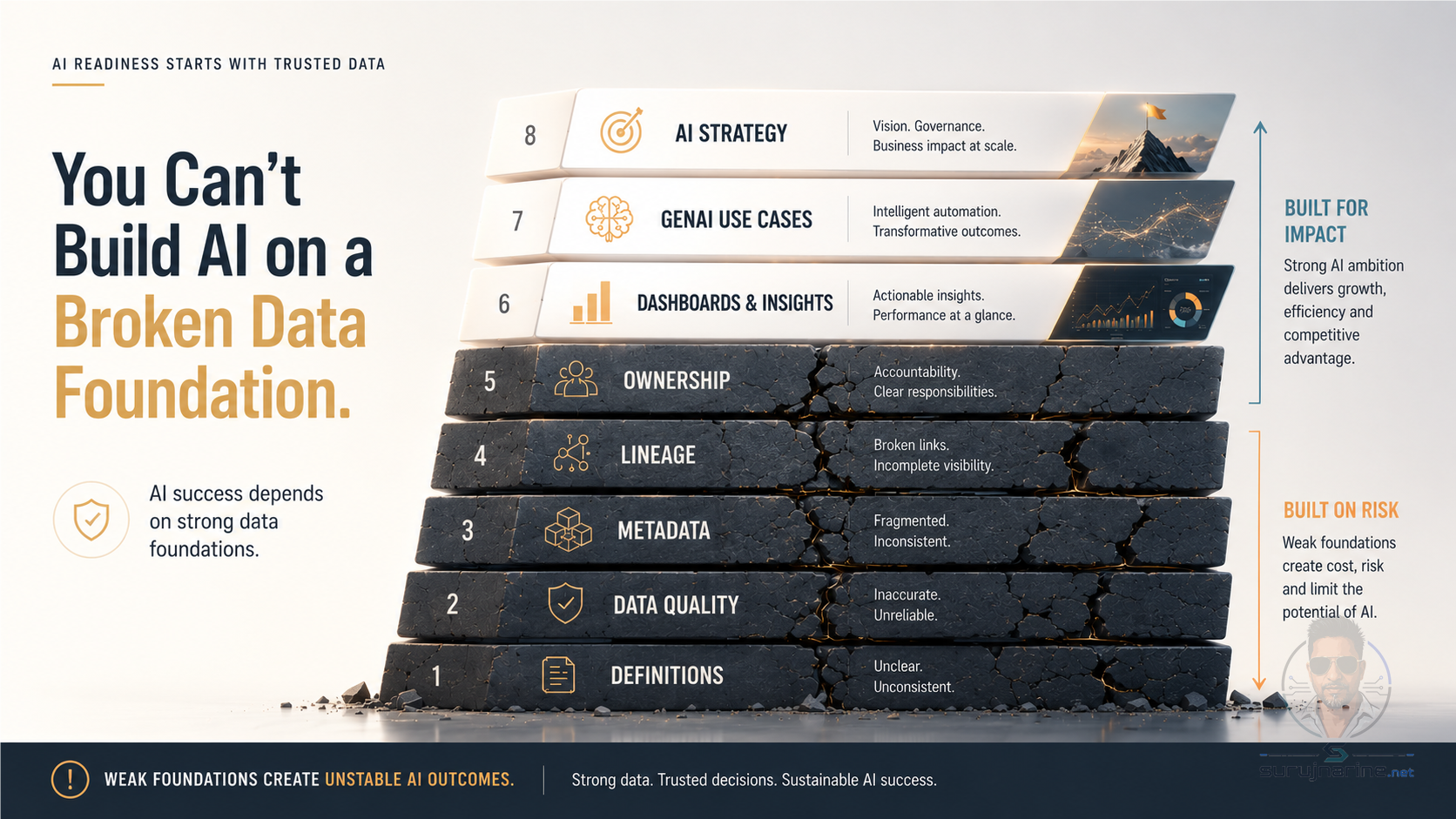
One of the clearest risks in enterprise AI right now is not the model.
It is the foundation underneath it.
A lot of organizations are racing to build the top floors:
- AI strategy
- GenAI use cases
- Dashboards and insights
- Copilots
- Internal assistants
- Workflow automation
But the lower layers are still shaky:
- Definitions
- Data quality
- Metadata
- Lineage
- Ownership
That is the real problem.
And it is one I keep seeing.
The AI Conversation Is Moving Too High, Too Fast
A lot of executive AI conversation starts at the top of the stack.
- How do we use AI to improve customer experience?
- How do we deploy copilots?
- How do we unlock better insights?
- How do we automate more work?
- How do we create competitive advantage?
Those are valid questions.
But many organizations are asking them before they have done enough work on the layers that actually support those ambitions.
That creates a dangerous mismatch.
The AI strategy sounds mature. The use cases sound exciting. The roadmap looks polished.
But underneath it all, the data still lacks consistency, trust, ownership, and structure.
That is how organizations end up building impressive AI narratives on unstable operational reality.
Data Unification Is Still the Business Imperative
Earlier this year, I wrote that unifying your data is now a business imperative, not just a platform discussion.
I still believe that.
In fact, I think it matters even more now.
Because AI does not reduce the importance of foundational data work. It increases it.
If data is fragmented, inconsistent, poorly governed, and disconnected from the business, AI does not magically resolve those weaknesses. It gives them speed, scale, and new ways to show up.
That is why so many AI initiatives look more advanced in PowerPoint than in production.
The problem is often not ambition.
It is that the foundation cannot support the ambition.
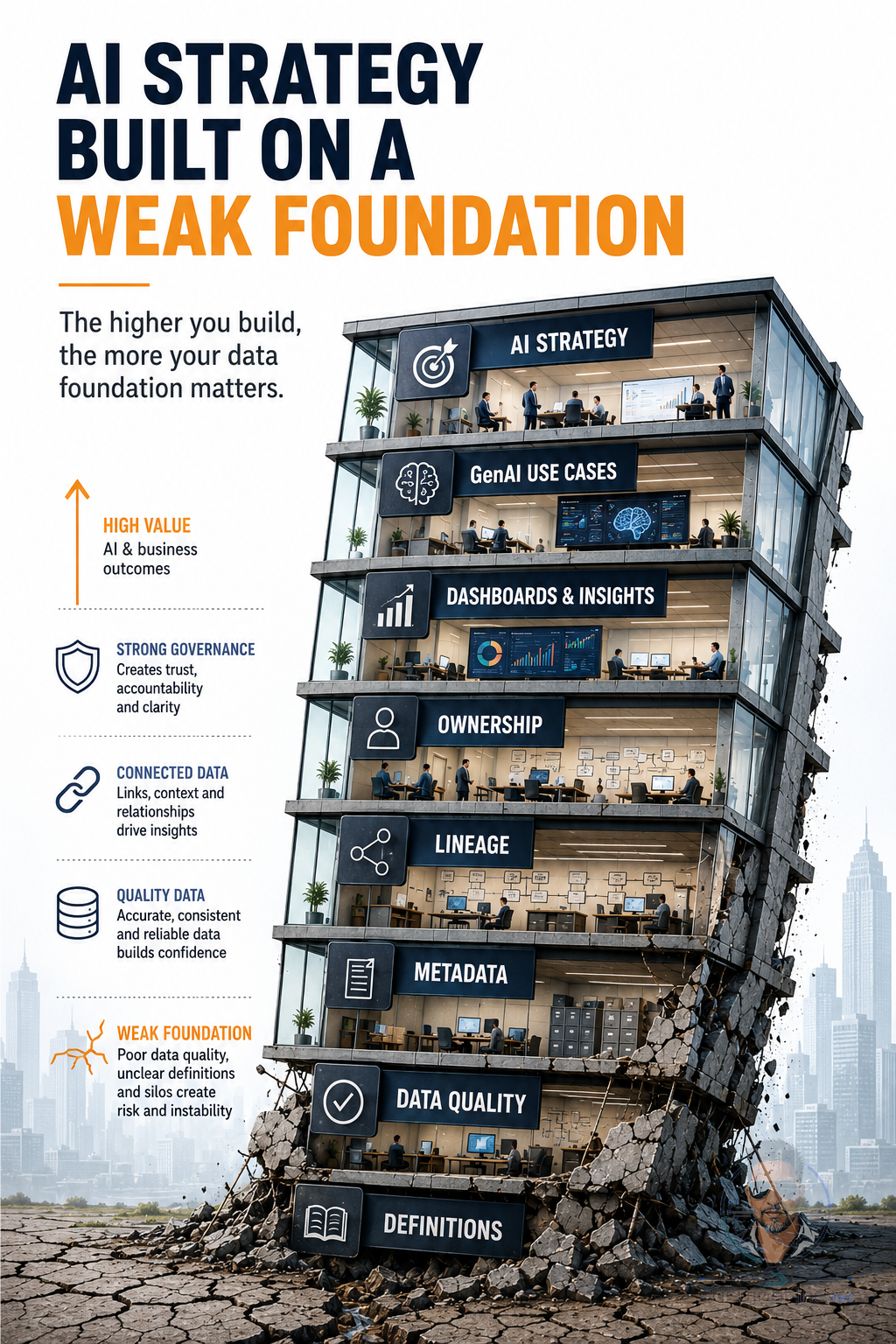
The Lower Layers Are the Load-Bearing Layers
This is what many organizations underestimate.
Definitions, data quality, metadata, lineage, and ownership can sound like back-office concerns compared to AI strategy and GenAI use cases.
They are not.
They are the load-bearing layers.
Definitions
If different teams use the same business terms in different ways, your analytics and AI outputs become harder to trust.
A model cannot fix organizational ambiguity that humans have not resolved.
Data Quality
If the inputs are inconsistent, incomplete, duplicated, or stale, then AI will often give you faster, more polished wrong answers.
Garbage in still matters. It just becomes more expensive when wrapped in confidence.
Metadata
Without strong metadata, it becomes harder to know what data exists, what it means, how it should be used, and what context should travel with it.
AI becomes more powerful when context is strong. Metadata is part of how organizations create that context.
Lineage
If you cannot trace where data came from, how it changed, and what systems touched it, then trust starts to break down.
That matters for analytics. It matters even more for AI.
Ownership
If nobody clearly owns the data, then governance becomes fuzzy, accountability weakens, and quality issues live longer than they should.
AI systems built on top of poorly owned data inherit that weakness.
These are not supporting details. These are the structural layers that determine whether higher-level AI capability can be trusted.
AI Amplifies What Is Already True
This is one of the most important things to understand.
AI is not neutral in its organizational impact.
It tends to amplify what is already present.
If the environment has clear ownership, good standards, trusted data, strong governance, and disciplined operations, AI can accelerate value.
If the environment has fragmented data, unclear definitions, weak controls, low trust, and inconsistent quality, AI can accelerate confusion.
That is why I often say AI does not just create new problems.
It exposes old ones faster.
And in some cases, it magnifies them.
Why This Becomes Even More Important With GenAI
The pressure gets even stronger with GenAI because GenAI often feels more accessible.
Traditional analytics usually forced organizations to confront data issues more directly. People expected some level of structure, governance, and quality before trusting the outputs.
GenAI can create the illusion that those requirements have softened.
Because the interface is easier. Because the output feels more natural.
Because the system sounds confident.
But that confidence can be misleading.
If a GenAI system is pulling from inconsistent enterprise data, poorly structured knowledge, weak metadata, or badly governed content, the user experience may still look smooth while the underlying trust problem remains unresolved.
In some ways, that makes the foundational issue more dangerous, not less.
The broken foundation is still there.
It is just easier to ignore because the interface is better.
This Is Not Mainly a Technology Problem
This is where many organizations still get it wrong.
They frame the problem as:
- We need a better platform.
- We need a better data lakehouse.
- We need better tooling.
- We need a better AI layer.
Those may all help.
But technology by itself does not create trust.
It does not create shared definitions. It does not create ownership. It does not create discipline. It does not create alignment between business and IT.
People do. Process does. Leadership does.
That is why I still see data unification as much more than a technical initiative.
It is an operating model issue.
It is a leadership issue.
And increasingly, it is an AI readiness issue.
The Real Question Is Whether the Business Trusts the Foundation
That is really what this comes down to.
Not whether the platform is modern. Not whether the dashboards are pretty.
Not whether the AI demo works.
The real question is:
Does the business trust the foundation enough to build on it?
If the answer is no, then the top floors are unstable no matter how impressive they look.
This is why many organizations experience the same pattern:
- Strong AI enthusiasm
- Fragmented implementation
- Uneven trust
- Slow adoption
- Limited production impact
They are trying to scale intelligence on top of unresolved data friction.
That does not usually end well.
This Is the Same Problem, Just Under More Pressure
In my March 16, 2026 article, Why Unifying Your Data Is Now a Business Imperative, I argued that data fragmentation, weak ownership, and inconsistent governance were already slowing decision-making and making analytics harder to trust.
I still believe that.
But I think the stakes are even higher now.
What was already a business and operating model issue has become an AI readiness issue too.
Because AI raises the cost of weak foundations.
If your definitions are inconsistent, your quality is uneven, your metadata is thin, your lineage is unclear, and your ownership is fuzzy, AI does not reduce that friction. It scales it. It makes bad assumptions easier to spread, weak governance harder to contain, and low-trust outputs faster to produce.
That is why I see this article as a continuation of that earlier argument.
Unifying your data is not just about making reporting cleaner or architecture simpler.
It is about making sure the foundation is strong enough to support everything organizations now want to build on top of it.
And in the age of AI, that is no longer optional.
My Takeaway
You cannot build a strong AI strategy on a broken data foundation.
Definitions matter. Data quality matters. Metadata matters. Lineage matters. Ownership matters.
These are not secondary concerns that can be cleaned up later.
They are the load-bearing layers underneath analytics, AI, and decision-making.
In the age of AI, data unification is not just a business imperative.
It is also a trust imperative.
Because the higher organizations try to build, the more dangerous a weak foundation becomes.
Related reading
Why Unifying Your Data Is Now a Business Imperative
Data unification is no longer just a platform project. It is a leadership, governance, and AI readiness priority.
Why the NIST AI RMF Matters More Now Than It Did a Year Ago
As AI moves from pilots into real workflows and agentic systems, the NIST AI Risk Management Framework becomes less abstract and more operational.
Don't Start With Agents. Start With the Simplest Architecture That Works.
A practical Microsoft AI stack decision framework for engineers: use code, RAG, SaaS agents, or custom agents based on the real requirements, not the hype.