
For years, the biggest questions in the AI data center world have sounded almost industrial: where will the power come from, how do you cool the systems, how fast can you deploy new capacity, and how do you keep scaling without running into the physical limits of land, grid access, water, and heat?
Now the answers are starting to get stranger.
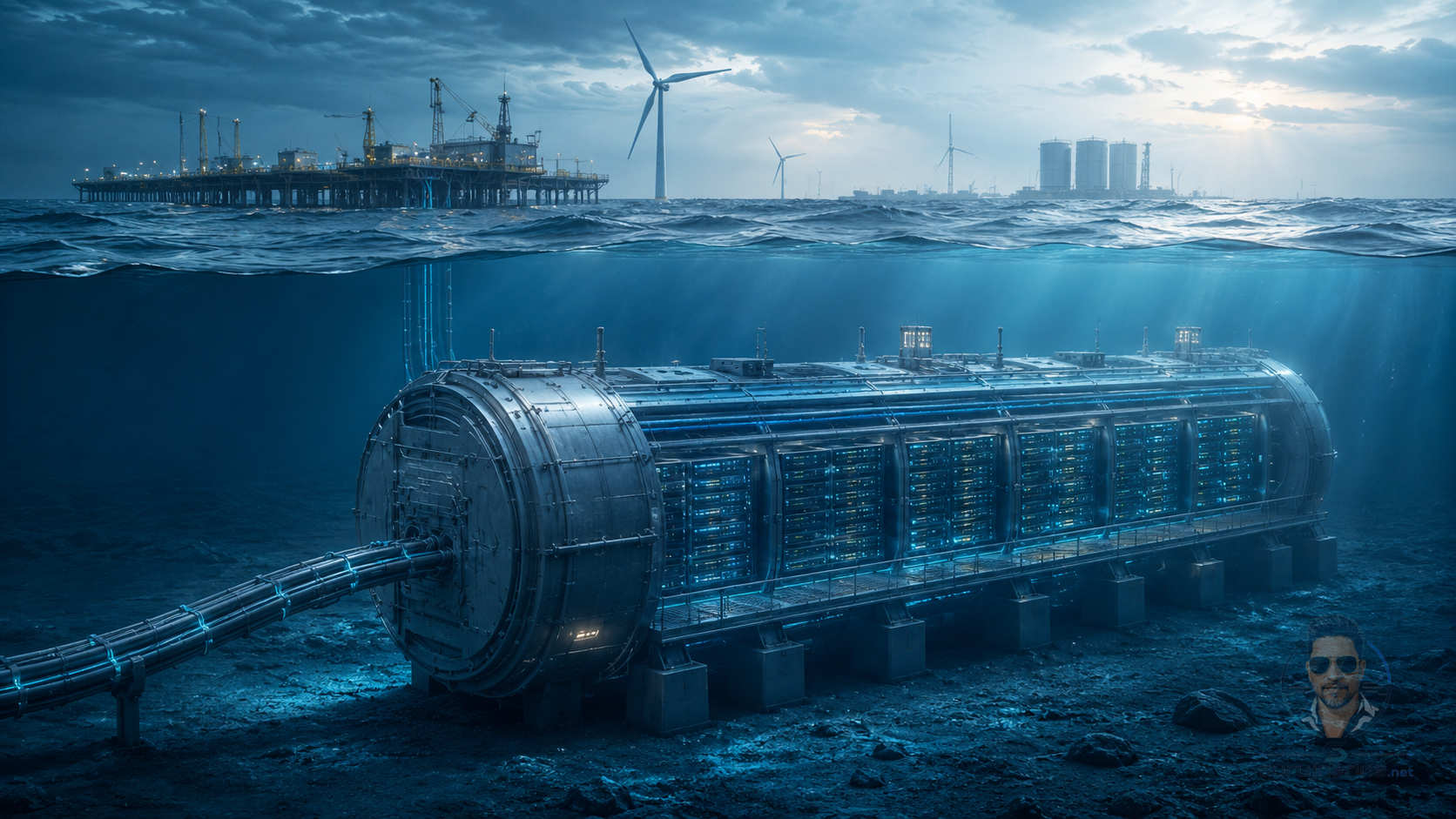
China has begun operating a commercial underwater data center off Shanghai, positioning it as the world's first wind-powered underwater facility. Reporting from WIRED and The Guardian describes a 24-megawatt project using submerged steel modules, seawater cooling, and nearby offshore wind power.
At first glance, this sounds like one of those eye-catching infrastructure experiments that may never matter beyond the headline. I do not think that is the right read.
This is better understood as a signal that the constraints around AI infrastructure are becoming so real that data center design is moving into places that used to feel impractical.
And that is exactly what makes this story worth paying attention to.
This Is Not a Random Idea
The concept of underwater data centers has been around for a while.
Microsoft explored it publicly through Project Natick, a research effort to test the feasibility of subsea data centers powered by offshore renewable energy. In its second phase, Microsoft deployed a full-scale underwater module in the North Sea and later reported that the concept was feasible, practical, and unusually reliable compared with a land-based control group.
Microsoft also patented the idea. Patent US20150382511A1, titled "Submerged datacenter," describes data center modules submerged in a body of water, using that environment for cooling and protection.
So when China moves from experiment to commercial deployment, this is not coming out of nowhere. It is building on an idea that major technology players have been exploring for years.
The important difference is that China appears to be pushing it further into operation.
Why This Matters Now
The timing is not accidental.
AI is turning data center design into a much more urgent physical problem. The International Energy Agency projects that global electricity consumption by data centers could rise to around 945 terawatt-hours by 2030, with AI one of the major drivers of that growth.
That is before you even get into cooling.
Cooling is no longer a background engineering detail. It is becoming one of the central economic and environmental constraints in AI infrastructure. The denser the compute, the more heat you need to remove. The more heat you need to remove, the more power, water, and mechanical complexity enter the equation.
That is where underwater data centers start to make sense.
Not as a gimmick, but as a response to a real systems problem.
Cooling Is Becoming a Strategic Variable
Traditional data centers already devote a meaningful share of power to cooling. In AI facilities, that challenge becomes more severe because of higher rack densities and more power-intensive workloads.
China's underwater approach is attractive for the simplest reason:
The ocean is a giant heat sink.
Reporting on the Shanghai project says the facility uses natural seawater cooling and is designed for a power usage effectiveness of no more than 1.15. The project is also described as reducing cooling-related energy demand, reducing land use, and avoiding the freshwater cooling burden of many conventional sites.
That is a compelling story in the current AI environment.
One of the biggest problems in scaling AI is not just getting more GPUs. It is getting:
- enough power
- enough cooling
- enough grid connectivity
- enough water
- enough land near useful network routes
- enough deployment speed to meet demand
Underwater architecture potentially changes several of those variables at once.
The Data Center Is Becoming an Environmental Design Problem
For a long time, data center conversations were dominated by compute and networking.
Now the physical environment matters more than ever.
The AI-era data center is increasingly shaped by:
- power availability
- thermal management
- water consumption
- proximity to renewable energy
- permitting and environmental constraints
- speed to deployment
- resilience and reliability
That is one reason the industry is experimenting with modular systems, liquid cooling, high-density rack design, nuclear-adjacent energy conversations, co-location with power assets, and now underwater placement.
In that context, the ocean is not just a strange place to put servers. It is one more answer to the question of how to sustain high-performance computing under mounting physical constraints.
Why China's Move Matters Strategically
What makes the Shanghai deployment especially interesting is not just that it exists. It is that it appears to be commercial and tied into a broader energy and industrial strategy.
The reporting around the site describes a project backed by domestic industrial partners, powered by offshore wind, and positioned as part of a larger push around AI infrastructure and clean energy integration.
That matters because the global AI race is increasingly becoming an infrastructure race.
The conversation is no longer just: which model is better?
It is also:
- Who can build enough infrastructure?
- Who can power it?
- Who can cool it?
- Who can do it cheaply enough?
- Who can do it fast enough?
That is where projects like this stop looking exotic and start looking strategic.
But It Is Not a Silver Bullet
Underwater data centers still come with real questions.
- Maintenance is harder.
- Deployment is more specialized.
- Environmental monitoring matters.
- Failures are more operationally complex.
- Regulatory and marine ecosystem concerns do not disappear.
Even Microsoft, despite positive Natick results, is no longer actively pursuing Project Natick as an operating program. Data Center Dynamics reported in 2024 that Microsoft had confirmed the effort was no longer active, even though the company said it would continue using learnings from the research.
That is a useful reminder.
A technology can be technically impressive and still not become the mainstream answer. So I would not frame this as "all AI data centers are going underwater."
I would frame it this way: the constraints are becoming serious enough that underwater deployment is now a rational option in at least some circumstances.
That alone is significant.
What This Says About the Future of AI Infrastructure
To me, the deeper lesson is that AI infrastructure is moving from a software scaling problem to a physical systems problem.
That changes the shape of competition.
The winners may not just be the companies with the best models. They may be the ones that solve for:
- energy access
- inference economics
- thermal design
- deployment velocity
- physical resilience
- infrastructure efficiency at scale
Underwater data centers are one response to that new reality.
Not the only response. Probably not the universal response. But a very telling one.
Once the industry starts pushing data centers offshore and beneath the sea, it is a sign that the old assumptions about where computing lives are starting to bend.
My Takeaway
China's underwater AI data center is not just an engineering curiosity.
It is a sign of where the pressure is building in the AI infrastructure world.
- Power is tightening.
- Cooling is becoming more expensive and more strategic.
- Water matters.
- Land matters.
- Grid access matters.
- Deployment speed matters.
Microsoft saw this early enough to explore Project Natick and patent the submerged data center concept. China now appears to be pushing that concept into commercial operation.
That does not mean the future of AI lives underwater.
But it does mean the future of AI will be shaped as much by thermodynamics, power systems, and physical infrastructure as by model breakthroughs.
And that is a shift more people should be paying attention to.
References
- WIRED - China Opens World's First Wind-Powered Underwater Data Center
- The Guardian - World's first wind-powered underwater datacentre starts operating in China
- Microsoft News - Microsoft finds underwater datacenters are reliable, practical and use energy sustainably
- Google Patents - US20150382511A1: Submerged datacenter
- International Energy Agency - Energy and AI
- Data Center Dynamics - Microsoft confirms Project Natick underwater data center is no more
Related reading
The AI Stack War: Microsoft Wants the Brain, NVIDIA Wants the Factory
Microsoft and NVIDIA are racing toward enterprise AI control from opposite ends of the stack: intelligence, tuning, inference economics, chips, and AI factories.
Microsoft's Real AI Power Move Is the Stack
Microsoft's Build 2026 AI announcements point beyond models toward enterprise tuning, inference economics, data centers, and full-stack AI strategy.
The AWS Outage Is a Reminder That the Cloud Still Has a Physical Layer
Heat, power, and cooling in Northern Virginia — why cloud resilience must be tested against physical reality, not just diagrams and failover plans.