
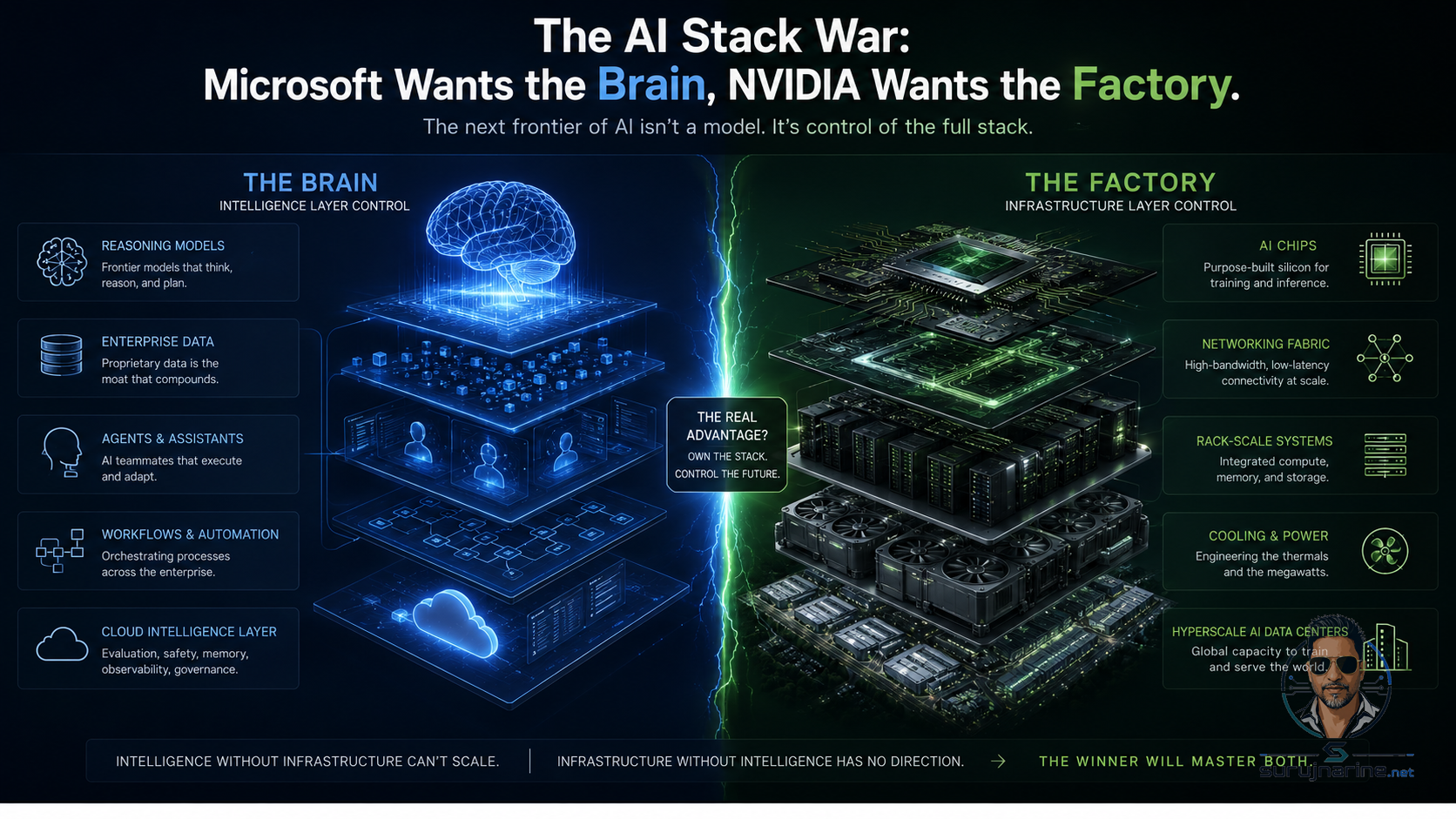
The AI race is no longer just a model race.
It is becoming a stack war.
That is the most important thing to understand about the recent moves from Microsoft and NVIDIA. On the surface, they look like two different kinds of companies making two different kinds of announcements.
Microsoft is pushing deeper into models, enterprise tuning, agents, and inference silicon. NVIDIA is pushing harder into AI factories, rack-scale infrastructure, inference software, networking, and full-stack data center architecture.
Both are moving toward the same destination: greater control over the economics, performance, and operational reality of AI at scale.
That is what makes the competition so interesting.
Microsoft appears to be moving from AI customer toward AI stack owner, trying to control more of the intelligence layer, enterprise integration layer, and cost structure of inference. NVIDIA, meanwhile, is moving from accelerator leader toward AI factory platform company, trying to make sure the future of enterprise AI still runs on infrastructure it defines from chip to interconnect to inference software to secure rack design.
This is no longer just a battle over who has the smartest model.
It is a battle over who can make AI operational.
Microsoft is climbing down the stack
Microsoft's recent AI announcements matter because they signal a broader ambition. The company is no longer content to simply provide access to frontier intelligence through partnerships and cloud distribution.
It is building more of its own reasoning, coding, voice, speech, and image models, while also pushing harder into enterprise tuning and its own inference silicon through Maia 200. Microsoft has framed Maia 200 as an inference accelerator designed to improve the economics of token generation, with native FP8 and FP4 support, 216GB of HBM3e, and 7 TB/s of memory bandwidth.
That matters because Microsoft's real strength has never been raw novelty alone.
Its strength has been operationalizing technology inside large enterprises. If Microsoft can combine good-enough-or-better model capability with tight enterprise workflow integration, private-data tuning, Azure distribution, and improved inference economics, it becomes a very serious player across much more of the stack.
That was the deeper message behind the announcements.
It is also why the McKinsey tuning claim got so much attention.
Microsoft is trying to own more of the brain.
NVIDIA is climbing up the stack
NVIDIA, by contrast, is moving from the bottom upward.
For years, the company's public identity was dominated by the GPU. That framing is now too narrow. NVIDIA's recent announcements make it clear that it wants to define the architecture of the AI data center itself.
At GTC 2026, Jensen Huang's keynote was framed around advances across the full AI stack, including accelerated computing, AI factories, open models, agentic systems, and physical AI. That language is not accidental. It reflects a strategic positioning shift.
NVIDIA is now pushing a much broader vision built around AI factories. In its own language, AI factories are the new infrastructure of intelligence: environments optimized not just for training models, but for producing tokens, reasoning at scale, and running agentic workflows reliably and efficiently in production.
The company's recent announcements around Vera Rubin, BlueField-4, Dynamo, MGX, and rack-scale systems all reinforce that point.
NVIDIA says the Vera Rubin platform integrates Rubin GPUs, Vera CPUs, BlueField-4 DPUs, and ConnectX-9 SuperNICs into rack-scale systems built for agentic AI. It also says Vera Rubin NVL72 can train large mixture-of-experts models with one-fourth the number of GPUs compared with Blackwell and can deliver dramatically better inference economics for certain workloads.
Those are not just product stats.
They are statements about who controls the economics of large-scale intelligence production.
NVIDIA wants to own the factory.
This is really a fight over AI economics
That is what ties Microsoft and NVIDIA together.
Both are responding to the same market reality: the next phase of AI will not be won by demos alone. It will be won by the companies that can make AI affordable, governable, performant, and deployable at production scale.
For Microsoft, that means pushing from the model layer downward: tuning intelligence for enterprise tasks, lowering inference cost, integrating with enterprise data, and embedding AI across products businesses already use.
For NVIDIA, that means pushing from the infrastructure layer upward: reducing token cost, increasing throughput per watt, improving networking efficiency, building secure rack-scale systems, and packaging inference as a full-stack operational platform through offerings like Dynamo and AI factory reference architectures.
NVIDIA says Dynamo 1.0 is now in production as open-source inference software for generative and agentic AI at scale, explicitly positioning it as an inference operating system for AI factories.
That makes the competition more interesting than a simple model-company-versus-chip-company story.
Both are trying to solve enterprise AI from different ends of the system.
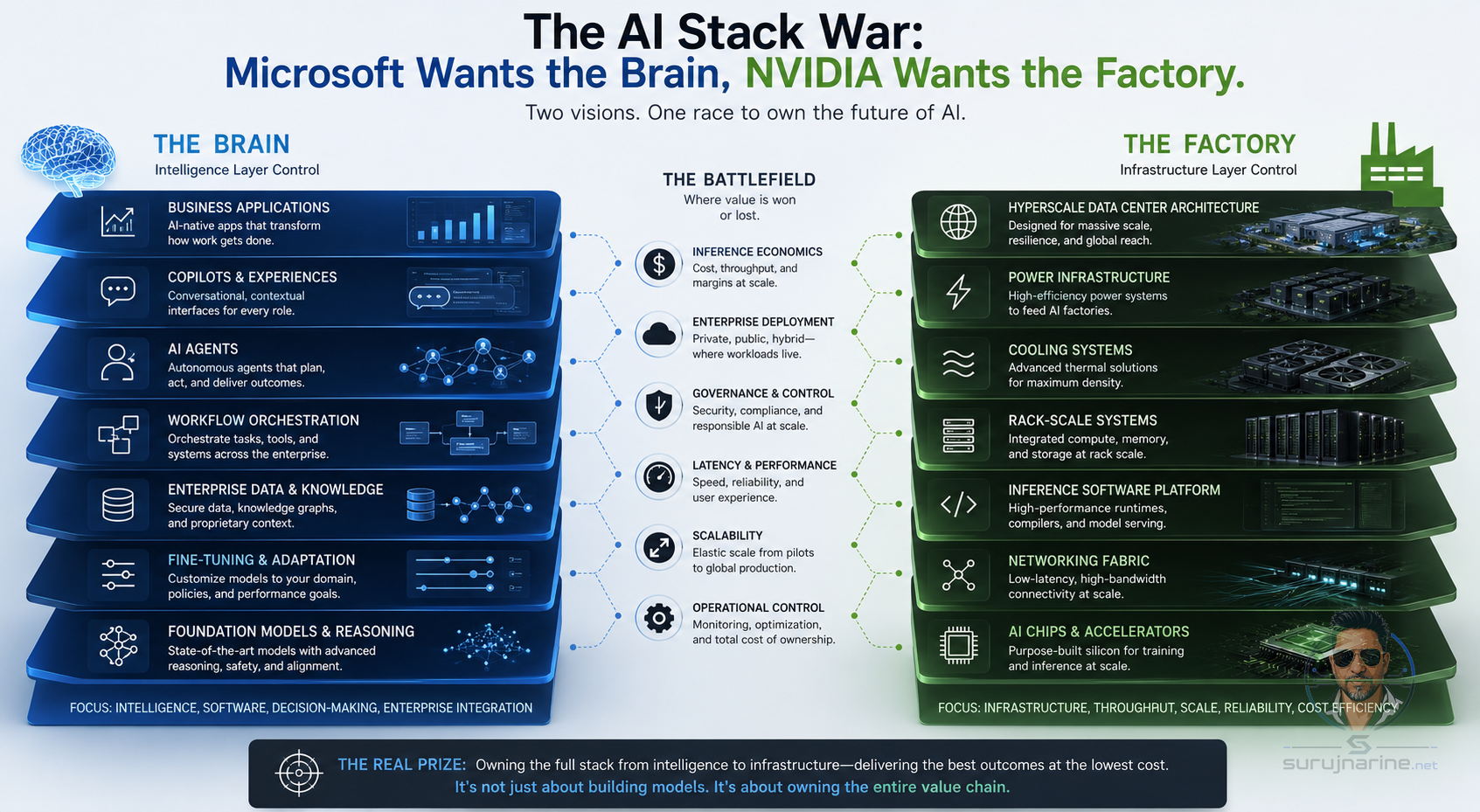
The data center is becoming the battlefield
There is also a deeper infrastructure story here.
AI is changing what a data center is for.
The classic cloud-era data center was designed around virtualization, storage, web applications, and general-purpose compute. The AI-era data center is increasingly shaped around token generation, long-context inference, model routing, memory bandwidth, networking, power delivery, and thermal efficiency.
NVIDIA's messaging around AI factories, 800V DC compatibility, MGX partners, and modular infrastructure is a direct response to that shift.
Microsoft's Maia 200 and broader AI infrastructure push are responding to the same trend from a different angle. If inference becomes the recurring operating cost center of enterprise AI, hyperscalers have strong incentives to optimize that layer themselves rather than rely entirely on external silicon economics.
That is one reason this story matters to anyone paying attention to cloud architecture and the future of the data center.
The future AI data center will be more specialized, more power-aware, more inference-centric, and more tightly co-designed around AI workloads than the cloud environments that came before it.
That makes the full-stack story much more important than it used to be.
Opposite ends, same prize
What makes this especially compelling is that both companies are converging on the same strategic destination from opposite ends.
Microsoft starts high in the stack:
- models
- enterprise data
- Copilot surfaces
- workflows
- cloud platform
- custom AI acceleration
NVIDIA starts low in the stack:
- accelerators
- interconnects
- networking
- DPUs
- inference operating systems
- rack-scale AI factory design
But both are aiming at the same prize:
Control over how enterprise AI gets built, delivered, and paid for.
Microsoft wants enterprises to trust its ecosystem to make AI useful inside business operations. NVIDIA wants everyone building that future, from cloud providers and AI labs to startups, nations, and enterprises, to depend on its definition of the AI factory underneath.
NVIDIA's recent ecosystem messaging explicitly emphasizes expanding global AI factory capacity to support agentic AI applications.
That is why this competition matters more than most people think.
It is not just about feature announcements.
It is about positioning for the next durable layer of value.
What this means for enterprise leaders
For CIOs, architects, platform leaders, and technology strategists, the takeaway is not that one company has already won.
The real takeaway is that the enterprise buying decision is changing.
The key question is becoming less about which single model looks most impressive in isolation, and more about which stack gives the best outcome across:
- quality
- cost
- latency
- security
- workflow fit
- governance
- operational manageability
That is a more mature enterprise question.
It also means the winners may not be the companies with the flashiest public demos. They may be the ones that make AI easiest to integrate into real work at an acceptable cost with a controllable risk profile.
That is why Microsoft's enterprise tuning story matters.
And it is why NVIDIA's AI factory strategy matters.
They are both trying to solve for operational reality.
My takeaway
The AI race is turning into a full-stack war.
Microsoft wants to own more of the intelligence layer: models, tuning, enterprise data integration, and inference economics.
NVIDIA wants to own more of the infrastructure layer: chips, networking, inference software, AI factory design, and the physical architecture of the next-generation data center.
- Both strategies are serious.
- Both are rational.
- Both are aimed at the same future.
The companies that shape the next phase of AI will not just be the ones that create intelligence.
They will be the ones that make intelligence into a system.
That is why this competition is worth watching so closely.
References
Related reading
Microsoft's Real AI Power Move Is the Stack
Microsoft's Build 2026 AI announcements point beyond models toward enterprise tuning, inference economics, data centers, and full-stack AI strategy.
The AWS Outage Is a Reminder That the Cloud Still Has a Physical Layer
Heat, power, and cooling in Northern Virginia — why cloud resilience must be tested against physical reality, not just diagrams and failover plans.