
A lot of enterprise AI strategy still sounds like software procurement.
- Buy the seats.
- Turn on the copilot.
- Pilot a few use cases.
- Wait for productivity to show up.
That approach was always too optimistic.
And Microsoft may have just said so out loud.
Reuters reports Microsoft has launched Microsoft Frontier Company, a new unit backed by $2.5 billion to help customers actually implement AI. The effort will embed thousands of engineers and industry experts inside customer environments to design, deploy, and optimize AI systems around real business goals.
That is not a small product update.
It is a signal.
The model is not enough.
The license is not enough.
The platform is not enough.
Someone still has to make the thing work.
The ROI gap is not between demo and deployment. It is between capability and operational reality
This is the part many organizations are still learning the hard way.
AI can look impressive in a demo and still fail in production.
Not because the model is weak.
Because the business process is messy.
Because the data is fragmented.
Because the workflow does not map cleanly to the tool.
Because the approvals are unclear.
Because nobody really owns the change.
Because "AI strategy" was never translated into operating reality.
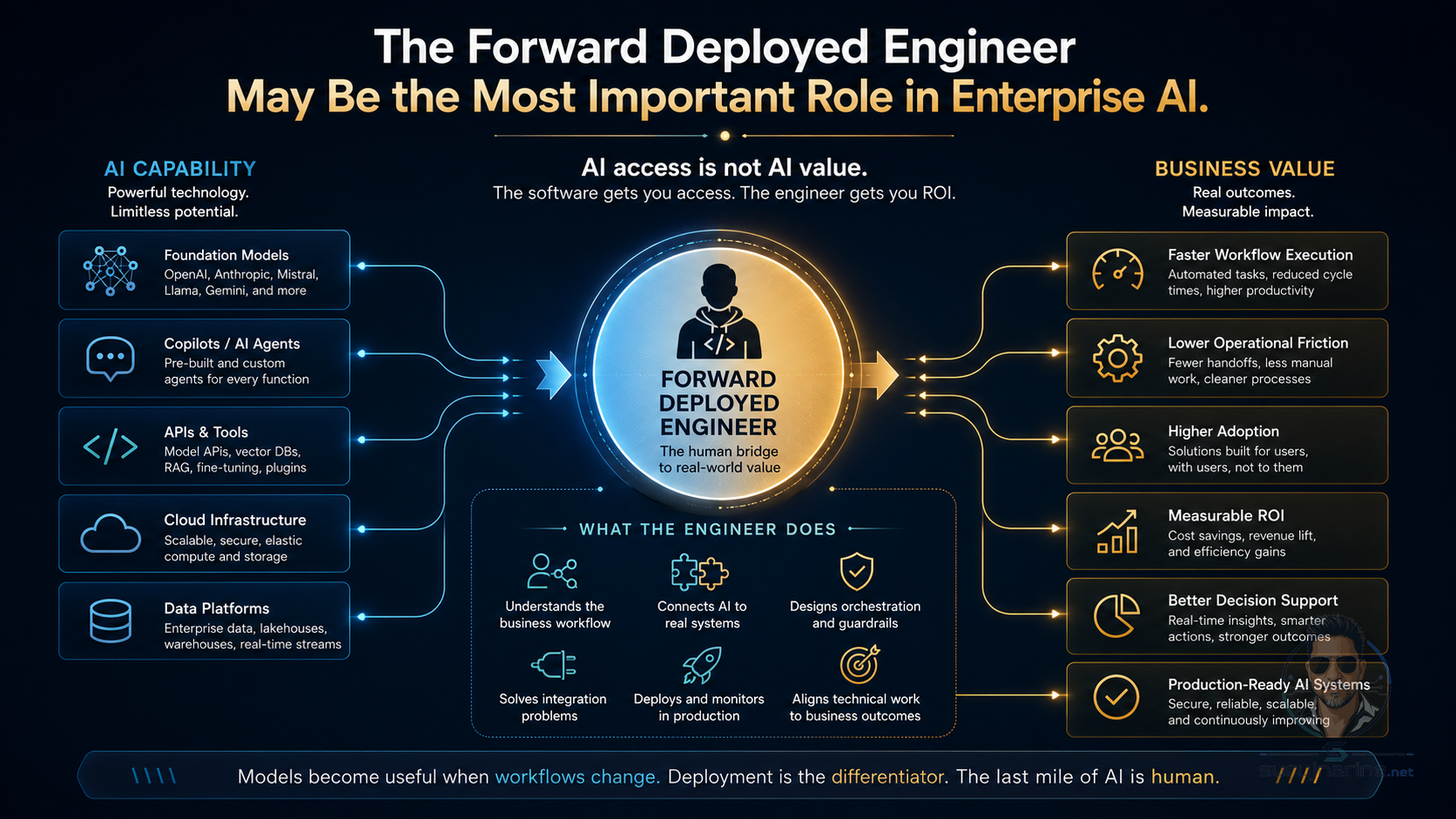
That is where the forward deployed engineer becomes so important.
This role sits in the gap between:
- technical capability
- organizational friction
- and measurable business outcomes
And that gap is where most AI initiatives live or die.
This is not a new pattern. It is a rediscovery
Palantir understood this years ago.
In Palantir's own description of the role, a Forward Deployed Software Engineer embeds directly with customers to configure Palantir's platforms around the customer's toughest problems. Palantir contrasts this with traditional software engineering by noting that a core engineer may build one capability for many customers, while the forward deployed engineer enables many capabilities for a single customer.
Palantir has since extended that model into Forward Deployed AI Engineers, whose job postings explicitly say they work directly with customers on GenAI strategy and implementation, build end-to-end workflows, take them to production, and feed field learnings back into the product suite.
That matters because it shows the role is not just a services wrapper.
It is an operating model.
And now the biggest platform companies are moving toward the same conclusion.
Why this role matters so much in AI
Traditional enterprise software could often be implemented through a familiar sequence:
- requirements gathering
- configuration
- integration
- training
- rollout
AI changes that.
Because AI systems are:
- probabilistic
- context-sensitive
- workflow-dependent
- data-dependent
- and highly sensitive to how they are embedded into human decision-making
That means the real work is not just enabling access to the model.
The real work is:
- figuring out where the model should sit in the workflow
- deciding what it should and should not do
- handling edge cases and escalation paths
- shaping the data and context layer
- tuning the human handoff
- measuring whether value is actually being created
- and adapting the system once reality starts pushing back
That is not just implementation.
That is translation.
And translation is exactly what a strong forward deployed engineer does.
The forward deployed engineer is part architect, part builder, part operator
This is why I think the role is so important.
A good forward deployed engineer is not just a consultant and not just a coder.
They are the person who can:
- understand the business objective
- understand the workflow
- understand the system constraints
- build or adapt the solution
- and stay close enough to execution to see whether it actually works
That combination is rare.
And in AI, it is extremely valuable.
Because enterprise AI is not won by having the smartest model in the abstract.
It is won by turning that capability into a system the business can actually use, trust, and operationalize.
That is why the role feels so significant to me.
It connects the AI layer to the business layer.
The software gets you access. The humans get you ROI
That is the blunt truth.
Reuters says Microsoft's new unit will help customers choose and customize models, including tools from Microsoft and outside vendors, while keeping the resulting implementations with the customer rather than absorbing that work back into Microsoft. Microsoft Commercial Business CEO Judson Althoff said customers want measurable outcomes, and that prior dependence on a single model provider had limited flexibility.
That is an important admission.
It means the problem was never just "which model should we buy?"
The problem is:
- how do we integrate this into the actual business?
- how do we rework the workflow around it?
- how do we connect it to data, systems, people, and accountability?
- and how do we keep refining it until it produces measurable value?
A software license may get you into the game.
But the forward deployed engineer is often the person who gets you across the gap between access and outcome.
This also changes how we should think about AI teams
For years, many AI conversations have centered on:
- model researchers
- data scientists
- ML engineers
- product teams
Those roles still matter.
But I think enterprise AI increasingly needs another type of person in the room: someone who can live at the intersection of:
- engineering
- workflow design
- systems integration
- business context
- and operational delivery
That is part of why the forward deployed engineer role is so compelling.
It is one of the clearest expressions of what enterprise AI really requires: not just intelligence, but implementation.
Not just capability, but adoption.
Not just software, but operational fit.
Why this matters beyond Microsoft
This is bigger than one company announcement.
When Microsoft launches a $2.5B embedded-AI-engineering unit, it is not just creating a services arm. It is validating a pattern that many operators already suspected: AI value is created less by model access alone than by the hard work of integrating that capability into real processes, real data, and real decisions.
That has implications for:
- CIOs buying AI tools
- vendors pitching "instant productivity"
- consulting firms building AI practices
- platform teams designing internal copilots
- and engineers deciding where the field is going
Because it suggests the next durable moat in enterprise AI may not be the model by itself.
It may be the people who know how to make the model useful.
My takeaway
I think the forward deployed engineer may become one of the most important roles in enterprise AI.
Not because the title is trendy.
Because the work is essential.
Someone has to connect the AI solution to the business objective.
Someone has to map it into real workflows.
Someone has to handle the messy reality between demo and production.
Someone has to stay with the system long enough to make sure it actually creates value.
That is the role.
And if one of the biggest AI vendors in the world is now putting billions behind embedding engineers inside customers to make AI work, then the market is telling us something important:
Enterprise AI ROI does not come from software alone.
It comes from the people who operationalize it.
References
- Reuters. "Microsoft launches firm to help companies adopt AI with $2.5 billion."
- Microsoft. "Microsoft Frontier Company: AI Outcomes at Enterprise Scale."
- Palantir Blog. "A Day in the Life of a Palantir Forward Deployed Software Engineer."
- Palantir Blog. "Dev versus Delta: Demystifying Engineering Roles at Palantir."
- Palantir. "Forward Deployed AI Engineer" job listing.
Related reading
Unleashing the Power of AI in the Enterprise: A Deep Dive into Jim Snabe's C3 Transform 2023 Keynote
Enterprise AI best practices from Jim Snabe's C3 Transform 2023 keynote: predictive management, phased adoption, sustainability, governance, and ethical change.
Don't Start With Agents. Start With the Simplest Architecture That Works.
A practical Microsoft AI stack decision framework for engineers: use code, RAG, SaaS agents, or custom agents based on the real requirements, not the hype.
Why Unifying Your Data Is Now a Business Imperative
Data unification is no longer just a platform project. It is a leadership, governance, and AI readiness priority.