
I installed OpenClaw expecting to be curious. I did not expect to have it adding real value within four hours.
I recently installed OpenClaw, and I came away very impressed with how quickly it started adding value. In about four hours, I had it running on an old X1 Carbon, rescheduling daily briefs based on Gmail and Google Calendar, reading a live threat feed and reporting back hourly, and monitoring three Linux machines on my network for changes to critical files and directories.
Basically, a poor man's Tripwire. All through Telegram.
That is what got my attention.
OpenClaw did not feel like a demo. It felt useful almost immediately.
Why it felt different
A lot of AI tools still ask the user to bring the work to the model: paste the context, describe the task, copy the result, move it into the real workflow, then repeat the same dance tomorrow.
OpenClaw felt different because it started moving closer to where the work already happens. The project describes itself as a personal AI assistant that runs on your own devices and answers through the channels you already use. That sounds simple, but in practice it changes the mental model.
Instead of a chatbot sitting outside the workflow, it becomes an always-on operator with context, memory, scheduled work, file access, and tools. That is why the early value showed up so quickly. The agent was not just answering questions. It was watching, checking, summarizing, and acting across real systems.
For a home lab or personal operations setup, that is powerful. The daily brief use case alone is useful. So is the hourly threat-feed summary. So is lightweight file-change monitoring across Linux boxes. None of those are impossible to build with scripts, cron, APIs, and alerting glue.
But the speed of assembly matters.
If an assistant can turn rough intent into working automation in the same afternoon, that is not just convenience. That is a meaningful shift in how small operational workflows get created.
The security concern arrives quickly too
But that is also where my main concern started to kick in.
The more capable these AI agents become, the more important it is to secure them properly. A local-first, always-on agent with memory, file access, and tool use is powerful, but it also raises real questions around access, isolation, guardrails, and oversight.
What identities does it use? Which files can it read? Which directories can it change? What happens if a prompt injection lands inside a feed, email, document, ticket, or chat message? What should require confirmation? What gets logged? How do you know whether the agent is still operating inside the boundaries you intended?
Those are not theoretical questions once the agent has tools. They become architecture questions.
Why NemoClaw caught my attention
That is why NVIDIA NemoClaw caught my attention during Jensen Huang's GTC keynote.
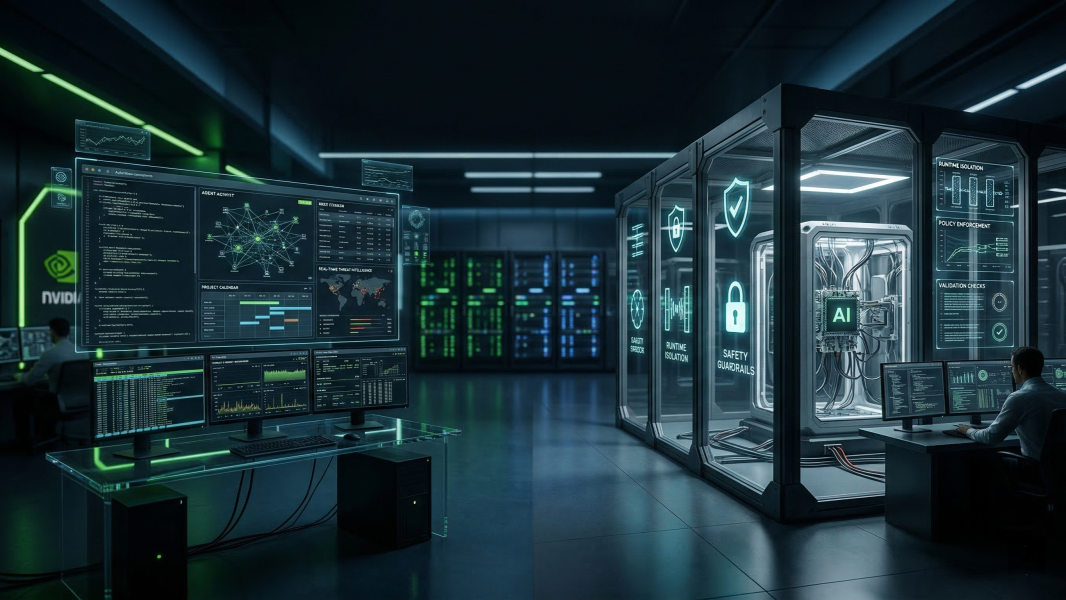
What interests me about NemoClaw is not just the technology itself. It is the fact that NVIDIA seems to be addressing the part of the AI agent conversation that matters most to me right now: how to run these systems more securely, with better containment, stronger guardrails, and a more practical path toward trust.
NVIDIA describes NemoClaw as a way to run agents like OpenClaw and Hermes inside NVIDIA OpenShell with managed inference. The product page emphasizes runtime controls, model routing, skill execution, state, observability, policy controls, lifecycle management, and sandboxing.
That is the right conversation. The industry is understandably focused on what AI agents can do. I am just as interested in how they are governed, monitored, and constrained once they start interacting with real systems and real data.
How I am thinking about OpenClaw vs. NemoClaw
OpenClaw
Fast personal utility
NemoClaw
Governed agent runtime
At least for now, I still think human-in-the-loop matters. Not as a brake on usefulness, but as a control point for high-impact actions.
Read-only summaries, daily briefs, and monitoring reports can be fairly low risk if the permissions are scoped well. Sending messages, changing schedules, modifying files, opening tickets, deploying code, or touching production systems are different categories of action. They need different levels of review.
The more useful the agent becomes, the more tempting it is to keep expanding its reach. That is exactly when discipline matters: least privilege, explicit tool boundaries, audit trails, sandboxed execution, scoped credentials, and clear approval rules.
The bigger story
To me, that is the bigger story.
OpenClaw shows how quickly AI agents can become useful. NemoClaw may end up being just as important for showing how they can be deployed more responsibly.
The future of agents will not be decided only by capability. It will be decided by whether people and organizations can trust these systems enough to let them operate near real work.
I will be testing NemoClaw next.
References
Topics: OpenClaw, NemoClaw, AI agents, agentic AI, AI security, cybersecurity, human-in-the-loop, enterprise AI, AI governance, and NVIDIA GTC.
Related reading
Don't Start With Agents. Start With the Simplest Architecture That Works.
A practical Microsoft AI stack decision framework for engineers: use code, RAG, SaaS agents, or custom agents based on the real requirements, not the hype.
AI Agents Need Managers Too
Why project management, agile delivery, and operating discipline become more important as AI agents enter real workflows.
The Double-Edged Sword of AI: Implications for Cybersecurity Professionals
A UIUC paper on autonomous LLM website exploitation highlights why cybersecurity teams need stronger monitoring, AI-aware defenses, and ethical AI governance.