
The signal is getting harder to ignore
The job impact of AI is no longer just a future-of-work panel topic. It is showing up in exposure studies, employer surveys, job postings, layoff language, and the way people use AI tools inside actual work.
The most important thing to say up front is that "AI exposure" is not the same thing as "this job disappears." A role can be exposed because AI can draft, summarize, classify, code, translate, answer customers, or analyze data inside that role. What happens next depends on economics, regulation, trust, workflow design, and whether the employer uses AI to augment people or replace tasks.
Still, the exposure numbers are too large to ignore. The IMF estimated that almost 40% of global employment is exposed to AI, rising to about 60% in advanced economies. The IMF also makes the more useful distinction: some exposed work may become more productive, while other exposed tasks may see lower labor demand, slower hiring, lower wages, or outright job loss.
The World Economic Forum's Future of Jobs Report 2025 frames the next few years as a period of churn rather than simple collapse. It projects 170 million new roles and 92 million displaced roles by 2030, for a net gain of 78 million jobs, but it also says 22% of jobs will be disrupted and nearly 40% of required skills will change.
More recent evidence points in the same direction. S&P Global's 2026 AI labor landscape found a modestly negative net employment impact from AI over the past 12 months in its PMI survey, while also noting that most deployments remain augmentative rather than fully autonomous. Anthropic's labor-market research is useful for a different reason: it tries to measure not just theoretical capability, but observed exposure, meaning the tasks where AI is actually being used in professional settings.
That is the world I wanted the site to track: not a clean replacement story, and not a comforting "nothing changes" story either. The truth is messier. Jobs are being decomposed into tasks, some tasks are becoming cheaper, some workers are becoming more productive, and some career ladders are going to feel pressure because junior-level work is often where automation starts.
Why I updated the site
I built jobs.skynetproxy.com because I wanted a place to watch the pattern develop without having to rely on scattered headlines. I am an engineer who is deeply interested in AI, and this is the kind of tool I naturally reach for: something visual, searchable, and grounded enough that I can keep improving it as the evidence changes.
The newest version is meant to feel more like a command center for AI job risk. The first screen gives visitors a fast way to search occupations, inspect risk, and see a few high-pressure roles immediately.
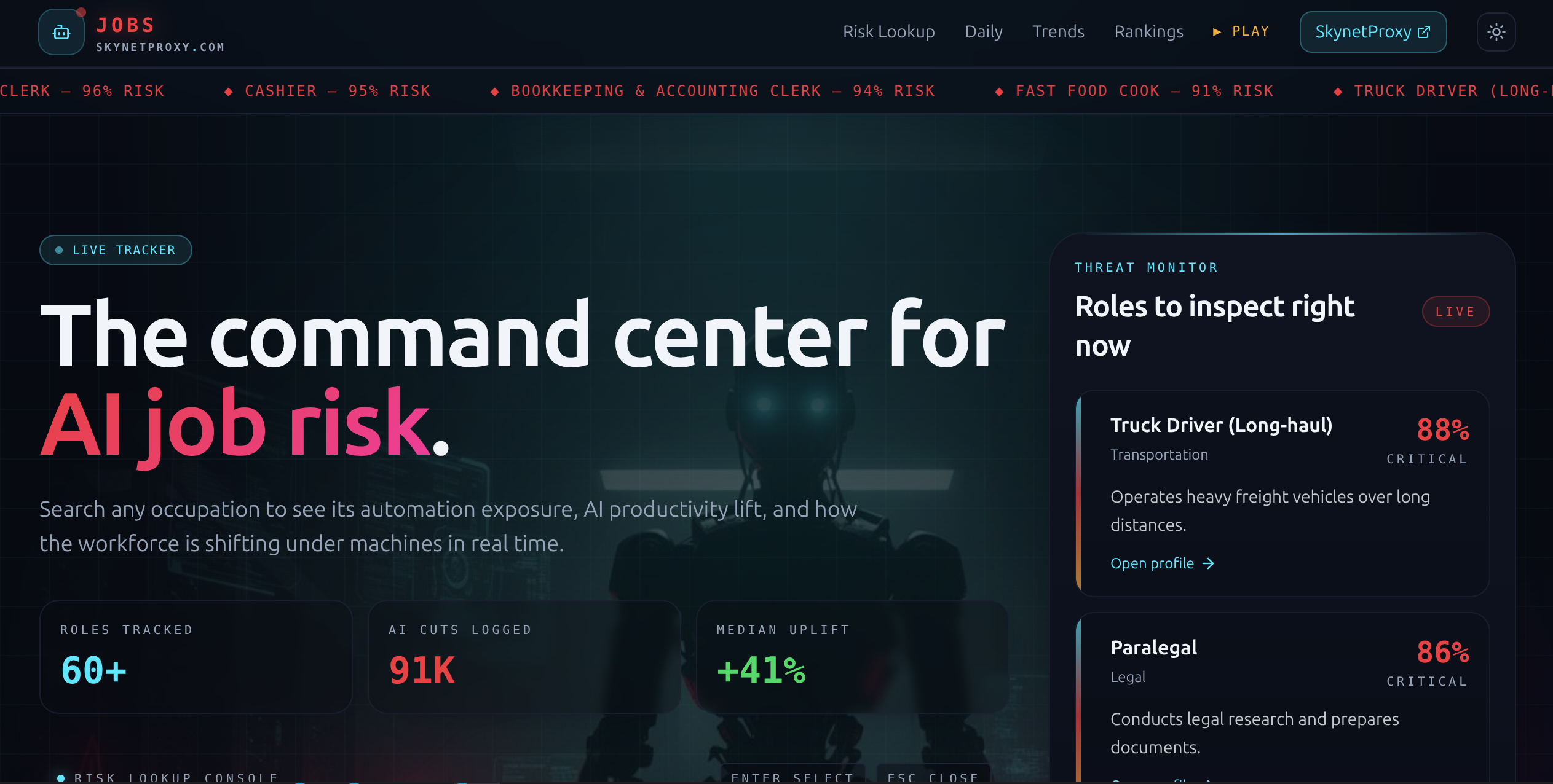
The point is not to sell a prediction. The point is to make the trend easier to follow. If someone is a student, a parent, a worker in a changing industry, or just a curious person trying to understand where this is going, they should be able to explore the signal without reading a stack of reports first.
The site currently combines several kinds of evidence: automation exposure, adoption trends, productivity studies, job-cut signals, robotics data, and role-level risk estimates. Some of those numbers are sourced from public institutions and research groups. Some are interpreted into a simplified score so they can be explored by normal people instead of buried in PDFs.
That last sentence is exactly why the next update mattered so much.
The sections of the tracker
The site is organized around a few simple sections.
Risk Lookup is the most direct entry point. Search for a role, inspect its risk score, and see why the role may be exposed. This is where the site tries to translate broad labor-market research into something a person can recognize: "What about my kind of work?"
Daily is intended to track current movement: layoff language, company announcements, new reports, and market signals that are worth watching. AI workforce change is not only happening through formal government statistics. Some of the earliest signals show up in earnings calls, job descriptions, tooling adoption, and company restructuring notes.
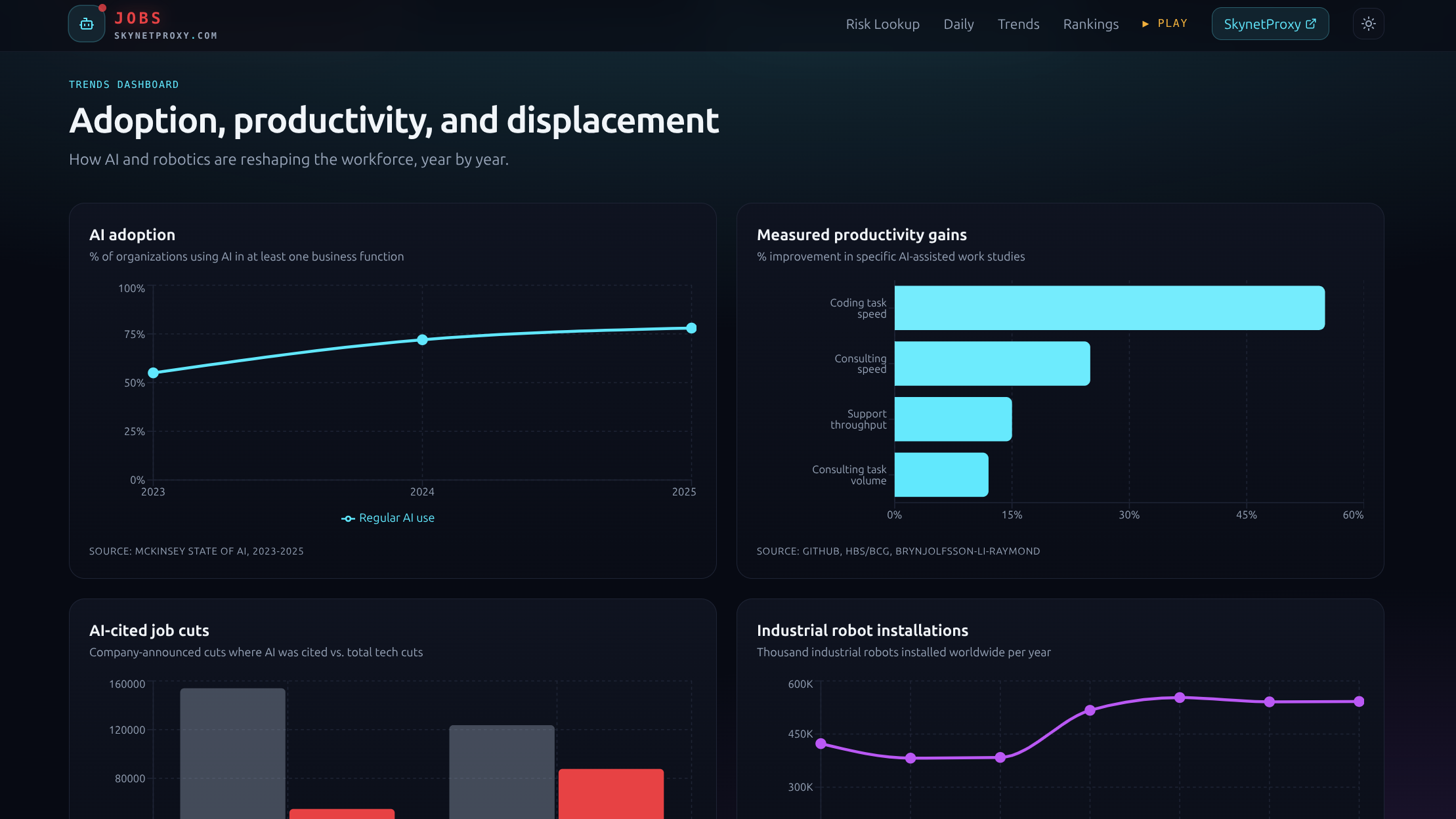
Trends gives the broader context. Adoption, productivity, displacement, and robotics are different signals. None of them should be treated as the whole story by itself, but together they help explain why the conversation keeps intensifying.
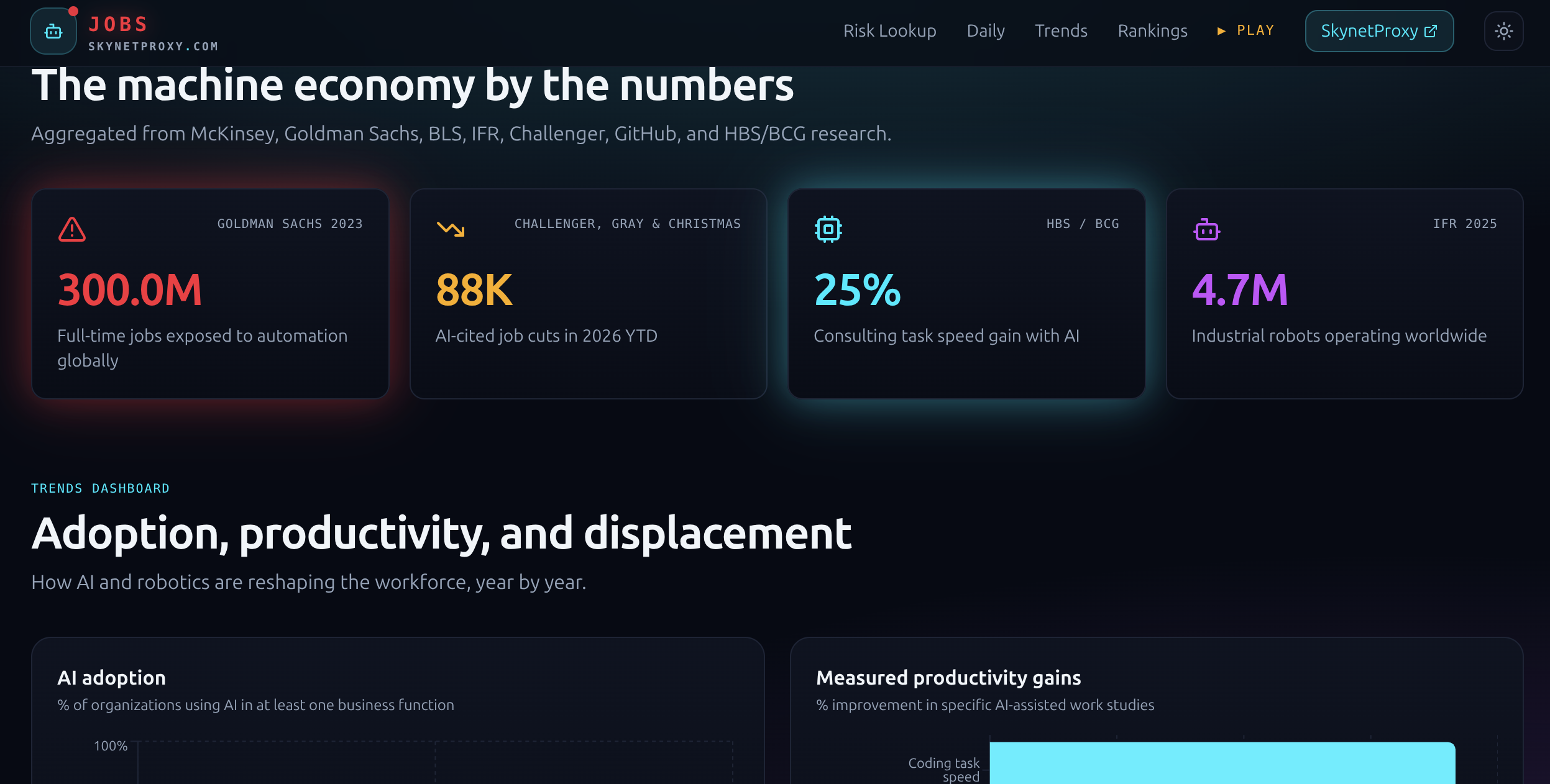
The trend dashboard is especially important because productivity is the hinge. If AI only makes people faster, employment may shift but not necessarily shrink. If the same output can be produced with fewer people, the labor-market effect becomes much sharper. The reality will probably differ by occupation and company size.
Rankings is where the site becomes more comparative. It shows roles that appear highly exposed, roles that look more resilient, and roles that may grow as the economy changes.
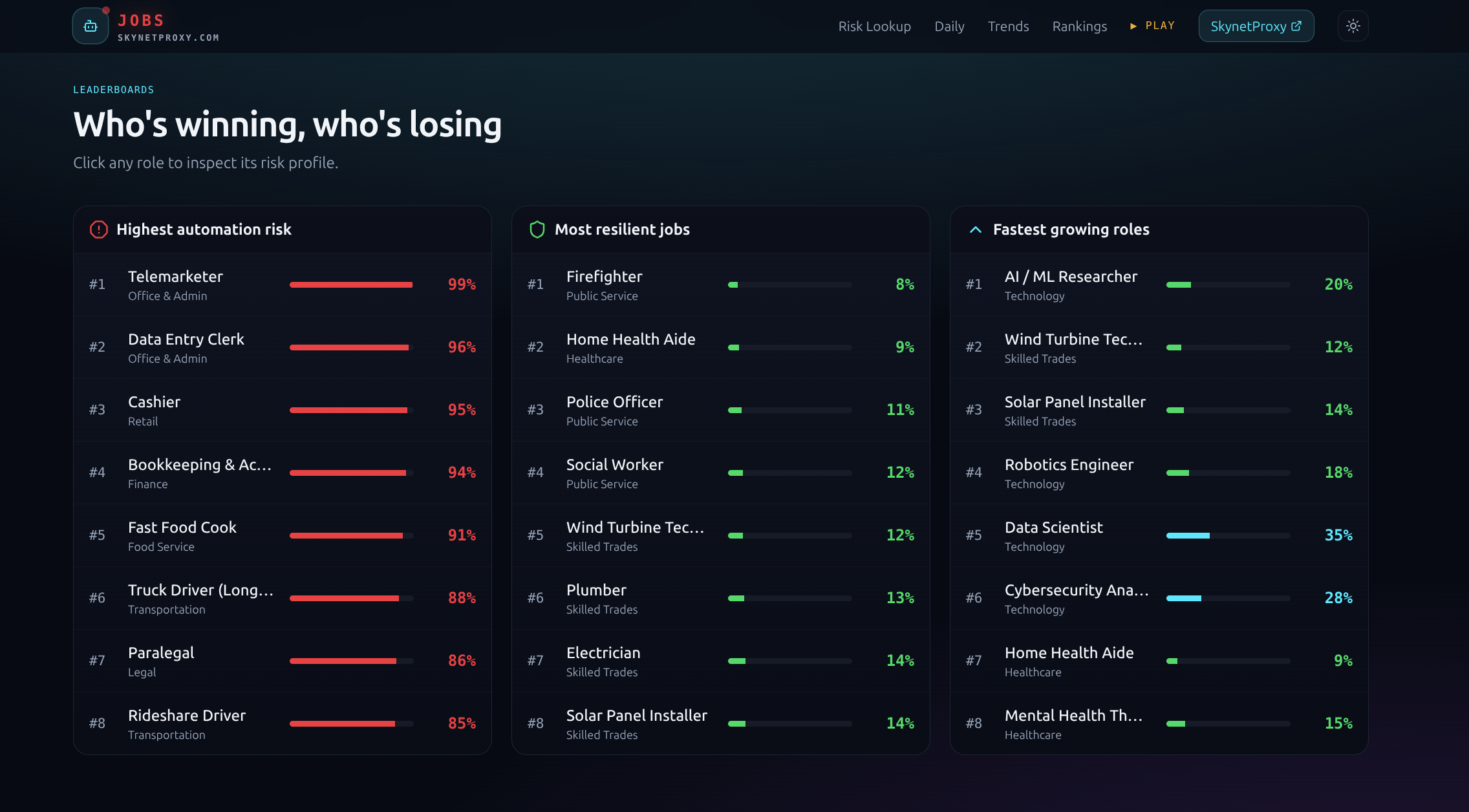
I like this framing because it avoids a single doom list. There are jobs under pressure, but there are also jobs likely to grow, jobs buffered by physical-world work, jobs protected by trust and accountability requirements, and jobs that may become more valuable because they sit close to AI implementation, governance, infrastructure, security, or human care.
Traceable artifacts matter
One of the most important updates is less flashy than the interface: I am trying to validate the data as much as possible and produce traceable artifacts.
That is why I created the public repository skynet-jobs-research. The repo is not the private application source code. It is the public evidence trail for the site: source references, methodology notes, data definitions, limitations, scoring notes, and change history.
The purpose is simple: if the site makes a claim, I want the supporting material to become easier to inspect. If a risk score changes, I want a path to explain why. If a source is weak, outdated, or only useful as a scenario, I want that caveat visible. If a number is modeled rather than observed, that should be clear.
This matters because AI labor discourse can get noisy fast. A company may cite AI in a layoff announcement because it is true, because it is convenient, or because the real story is a mix of cost pressure, strategy, and automation. A research report may estimate exposure, but exposure is not displacement. A productivity study may show huge gains in one task and say very little about a full occupation.
So the tracker needs to be humble about certainty while still being useful. My goal is to separate:
- observed data;
- source-reported estimates;
- modeled exposure;
- analyst interpretation;
- forecasts and scenarios.
That is the kind of discipline I want the public repo to enforce over time. It gives the project a memory. It makes updates reviewable. It also makes the site more useful to people who care about the evidence, not just the interface.
What I want this to become
Right now, jobs.skynetproxy.com is a focused tracker for AI job risk and labor-market signals. Over time, I want it to become a broader resource for people trying to adapt.
That may include reskilling resources, adjacent-role suggestions, learning paths, practical AI literacy guidance, or a way to compare how different occupations might change rather than simply ranking them by risk. The site should eventually help answer a better question than "Will AI take my job?"
The better question is:
What parts of this work are changing, what evidence supports that, and what can a person do next?
That is the spirit of the project. It is not a polished corporate product pretending to know the future. It is the work of an engineer trying to build a useful public resource while the ground is moving.
AI is already changing labor markets. The impact will not be evenly distributed, and it will not be captured by one number. But if we make the evidence visible, keep the assumptions traceable, and keep improving the model, we can at least give people a better map.
Related reading
You Can't Build AI on a Broken Data Foundation
Enterprise AI strategy depends on data foundations: definitions, quality, metadata, lineage, ownership, governance, and business trust.
Why the NIST AI RMF Matters More Now Than It Did a Year Ago
As AI moves from pilots into real workflows and agentic systems, the NIST AI Risk Management Framework becomes less abstract and more operational.
AI Agents Need Managers Too
Why project management, agile delivery, and operating discipline become more important as AI agents enter real workflows.