
South Korea's latest AI and semiconductor push is a reminder that the AI race is no longer just about models, apps, or copilots.
It is becoming a race to build the physical system underneath them.
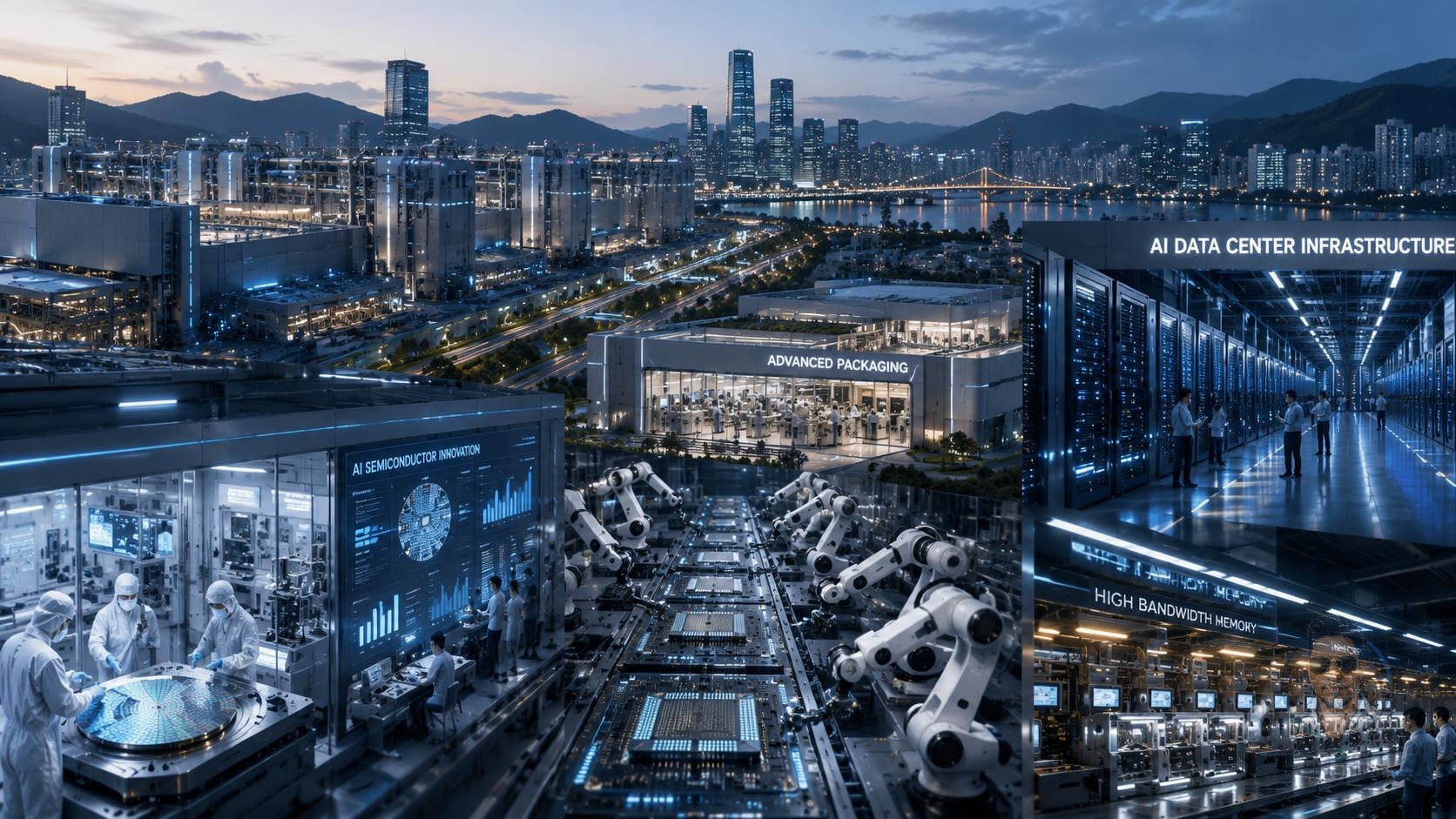
Reuters reported that South Korea announced three "mega projects" spanning semiconductors, physical AI, and AI data centers, with Samsung, SK Group, and government ministries laying out major investment plans. Samsung said it plans 400 trillion won in new semiconductor fabs in Gwangju and 56 trillion won for advanced high-bandwidth-memory fabs in Cheonan and Onyang, while SK Group outlined long-term semiconductor and AI data center projects measured in the hundreds of trillions of won. The government also said SK, GS Group, and Naver would invest about 550 trillion won in an initial phase of AI data centers targeting 8.4 GW of capacity, with construction slated to begin by the first half of 2028.
That is not a software story.
That is industrial policy.
The real contest has moved below the application layer
For years, much of the public conversation around AI has focused on what happens at the top of the stack:
- better models
- better interfaces
- better products
- better agents
Those things matter.
But the countries and companies that want to lead in AI are increasingly being forced to compete much lower in the stack:
- chips
- memory
- advanced packaging
- power
- data centers
- robotics
- workforce
- and supply-chain resilience
South Korea's announcement makes that explicit. Reuters reported that the government wants the country to become one of the world's top three AI robot powers and the world's top power in physical AI by 2030, while also training 10,000 AI robotics specialists over five years.
That is the language of national capability building, not just tech-sector optimism.
Samsung and SK Hynix are not just companies here. They are strategic infrastructure
One reason this matters is that Samsung and SK Hynix already sit in a uniquely important part of the global AI value chain.
Reuters noted that South Korea is emerging as a major winner from the AI investment surge because Samsung and SK Hynix hold commanding positions in high-bandwidth memory, a critical component for advanced AI processors. Reuters also reported that the government hopes to double South Korea's memory chip production capacity within five years.
That makes this more than an ordinary corporate expansion plan.
It is a national bet built around an existing strategic advantage.
In the current AI cycle, compute is not just about logic chips. Memory matters enormously, and advanced packaging matters along with it. The countries that control more of that chain have leverage that goes far beyond domestic economic development. Samsung's and SK Hynix's position in HBM effectively gives South Korea a stronger seat at the table in the global AI buildout.
This is what AI leadership looks like when it gets real
There is a temptation to think of AI leadership as something determined mostly by model quality or by which company ships the most impressive assistant.
But once AI moves from novelty to infrastructure, leadership starts to look different.
It looks like:
- fab construction timelines
- power and water access
- data center capacity
- packaging bottlenecks
- training pipelines for technical talent
- government permitting speed
- and the willingness to commit capital at industrial scale
Reuters reported that South Korea's government is promising to fast-track approvals and accelerate major cluster construction, while Samsung and SK Hynix are shortening timelines at Yongin to bring additional capacity online sooner.
That is a useful reminder: AI is not just a software revolution. It is becoming a race to align industrial capacity with algorithmic ambition.
The data center portion may be the most underappreciated part
The semiconductor headlines will understandably get most of the attention.
But the AI data center component is just as important.
Reuters reported that South Korea's initial AI data center phase targets 8.4 GW of capacity, backed by about 550 trillion won from SK, GS Group, and Naver, with potential expansion to more than 1,000 trillion won by around 2035.
That matters because the next phase of AI competition is increasingly constrained by physical infrastructure:
- where capacity can be built
- where electricity can be delivered
- where cooling can be managed
- and how quickly new demand can be absorbed
In other words, data center strategy is becoming part of national AI strategy.
That is why this story should not be read as just "South Korea supports chips." It is a much broader attempt to build a domestic AI production system.
Physical AI and robotics make this even more interesting
Another reason the announcement stands out is that it does not stop at semiconductors and data centers.
Reuters reported that the government's three-project framework also includes physical AI and robotics, with a goal of commercializing humanoids tailored to 10 major industries by 2028, helping establish data factories, supporting Korean physical AI foundation models, and making South Korea one of the world's top three AI robot powers by 2030.
That broadens the meaning of the investment.
This is not only about supplying memory into someone else's AI ecosystem.
It is also about trying to shape downstream applications in robotics and embodied AI.
That is important because the real long-term winners in AI may not be the countries that only manufacture components. They may be the ones that can connect:
- chips
- data centers
- models
- robotics
- and domestic industry adoption
South Korea appears to be trying to build exactly that bridge.
Big bets create big risks
Of course, this is not a guaranteed success story.
Reuters' follow-up analysis makes clear that these investments are also a massive gamble on the durability of the AI boom. Analysts told Reuters that boosting chip capex over the next decade raises the risk of oversupply if AI spending cools, and Reuters noted that both Samsung and SK Hynix carry memories of painful prior downturns in the memory business. SK Hynix nearly went bankrupt in 2001, and both companies posted major losses in 2023 during the last slump.
That is what makes the story especially interesting.
South Korea is not just spending into strength.
It is committing enormous capital into a market that still carries real cyclicality risk.
Reuters reported that Samsung's domestic investment plan stretches to 2040 and can be adjusted based on market conditions, while SK Hynix also said execution would be staged according to demand and board approvals.
So this is not blind confidence.
It is a strategic bet made with the knowledge that semiconductor booms have punished overbuilders before.
What this says about the broader AI race
To me, the strongest takeaway is that AI competition is increasingly becoming a contest of national systems.
Not just models.
Not just startups.
Not just software.
Systems.
South Korea's move shows that serious AI ambition now requires coordination across:
- private capital
- industrial policy
- energy and infrastructure planning
- technical workforce development
- and long-horizon manufacturing strategy
That is the framing that matters here: AI is not just a software revolution. It is becoming an industrial policy race.
And once you see it that way, the story changes.
The key question is no longer just:
Who has the smartest model?
It becomes:
Who can manufacture the chips, package the memory, build the data centers, train the talent, and keep the whole machine fed with enough power and capacity to scale?
That is a much harder race to run.
My takeaway
South Korea's $576 billion AI and semiconductor push is a reminder that the future of AI will be shaped as much by factories, power, packaging, and data centers as by models and apps. Reuters' reporting makes clear that this is a broad attempt to align semiconductors, HBM, AI data centers, robotics, and talent into a national capability-building strategy.
That does not mean every country can or should copy it.
But it does mean the nature of AI competition is changing.
The countries that treat AI as an industrial system may have a major advantage over the ones that still treat it mainly as a software trend.
And that may be one of the most important shifts happening in technology right now.
References
- Reuters. "Factbox: Key facts on South Korea's three chip and AI 'mega projects.'" June 29, 2026.
- Reuters. "Analysis: Samsung, SK Hynix mega South Korea chips gamble tests optimism of AI cycle." June 30, 2026.
Related reading
Exploring the NVIDIA GPU Software Ecosystem: Unveiling Opportunities and Insights
A practical overview of NVIDIA's GPU software ecosystem, from CUDA and AI to high-performance computing, rendering, healthcare, and developer opportunity.
The AI Stack War: Microsoft Wants the Brain, NVIDIA Wants the Factory
Microsoft and NVIDIA are racing toward enterprise AI control from opposite ends of the stack: intelligence, tuning, inference economics, chips, and AI factories.
The Ocean May Become the Next AI Data Center
China's wind-powered underwater data center shows how AI infrastructure is running into power, cooling, water, land, and grid constraints.