
AI agents are getting more capable, but the real question is whether we can trust them.
That was my biggest takeaway from NVIDIA's work around OpenShell and NemoClaw.
The industry has focused heavily on what agents can do: persist across sessions, use tools, spawn subagents, interact with real systems, write code, retrieve context, and keep working after the user walks away. Impressive, yes. But from a security and operations perspective, that is exactly where the conversation gets more serious.
An agent with shell access, credentials, network connectivity, memory, and the ability to evolve over time is not just a smarter assistant. It is a very different risk model.
Capability without containment is not maturity. It is exposure.
Agents change the risk model
Traditional applications usually expose a defined set of features. Users click buttons, submit forms, call APIs, and operate inside a relatively predictable interaction model. Agents are different because they can decide which tools to use, in what order, and with what interpretation of the surrounding context.
That changes the security posture. A workflow engine executes a workflow. An agent may choose a workflow, modify it, ask another agent for help, read more context, call a tool, and then continue. That flexibility is the value. It is also the risk.
The failure modes become more subtle: the agent misunderstands a goal, overreaches on a tool call, leaks context to the wrong model, follows malicious instructions embedded in a document, or takes an action that is technically allowed but operationally unsafe.
The controls need to live outside the agent
What stood out to me about OpenShell is the emphasis on controls outside the agent itself: sandboxing, policy enforcement, privacy routing, and deny-by-default principles. To me, that is the right direction.
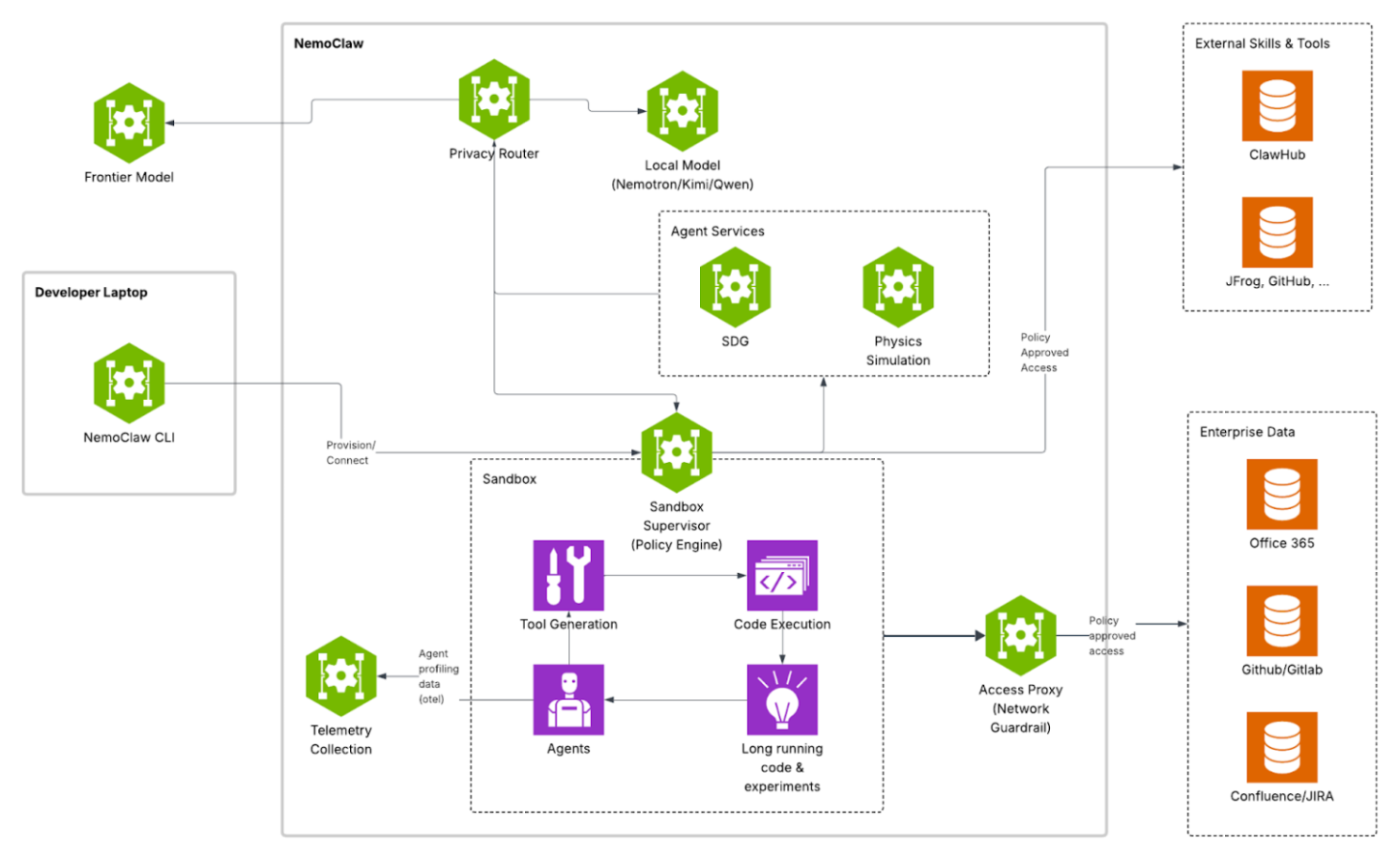
We should not expect an agent to be its own entire security boundary. Prompts are useful. System instructions matter. Model behavior matters. But production trust cannot depend only on the model choosing to behave.
The controls that matter
Trustworthy agents need controls outside the model, not just better prompts inside it.
Sandboxing
Limit what the agent can touch so experimentation does not automatically become access to the whole environment.
Policy enforcement
Define what actions are allowed, denied, reviewed, or routed through stronger approval paths.
Privacy routing
Control where sensitive context goes, which models can see it, and what must stay local or isolated.
Deny by default
Treat tool use as a permissioned act, not an open-ended capability granted because the agent asked nicely.
Observability
Capture prompts, tool calls, data access, decisions, and outcomes so operators can reconstruct what happened.
Lifecycle management
Version, update, monitor, suspend, and retire agents like any other production system with real blast radius.
This is the same lesson enterprise technology keeps relearning. Identity belongs outside the application. Network policy belongs outside the workload. Audit logs belong outside the user session. Backups belong outside the system they protect. Agent controls should follow that same pattern.
Deny by default is the right instinct
Deny by default matters because agents are good at finding paths. That is part of why they are useful. Give an agent enough tools, context, and permission, and it may discover a way to accomplish the task that the human did not explicitly imagine.
Sometimes that is wonderful. Sometimes it is exactly the kind of behavior security teams are paid to worry about.
A trustworthy agent environment should make the safe path easy and the unsafe path structurally difficult. Tool calls should be scoped. High-impact actions should require approval. Sensitive data should have routing rules. Network access should be explicit. Agents should not inherit broad access simply because the user running them has broad access.
Trust is also an operations problem
Security is only one part of this. Operations matter just as much. If an agent is always on, then someone needs to know whether it is healthy, what it changed, what it attempted, when it escalated, when it failed, and whether its behavior has drifted.
That is why observability is not optional. Logs should not be an afterthought bolted on after the first incident. They should be part of the architecture from the start.
For enterprise environments, I would want to see every meaningful action tied back to an identity, a policy decision, a tool call, source context, and an outcome. If the agent touched a file, called an API, created a ticket, queried a database, or invoked another agent, that should be visible.
This is what enterprise readiness really means
Enterprise readiness is not just single sign-on and a procurement checklist. For agentic systems, it means the organization can answer basic questions with confidence:
- What can this agent access?
- Which tools can it call without approval?
- Which actions require human review?
- Where can sensitive data be sent?
- How are agent versions, prompts, policies, and tool permissions changed?
- Can we replay or reconstruct what happened after an incident?
If those questions are hard to answer, the agent may still be useful, but it is not yet ready for broad trust.
The future depends on trust
The future of AI agents will not be decided only by how autonomous they are. It will be decided by how securely they can operate.
The more useful agents become, the closer they move to real systems, real data, and real operational consequences. That is where capability has to be matched with containment, governance, monitoring, and accountability.
Autonomy is impressive. Trust is what makes it deployable.
References
Topics: AI agents, agentic AI, AI security, cybersecurity, trustworthy AI, OpenShell, NemoClaw, enterprise AI, AI governance, and NVIDIA.
Related reading
I Installed OpenClaw Expecting to Be Curious. I Did Not Expect Real Value Within Four Hours.
OpenClaw quickly became useful for briefs, threat feeds, and home-lab monitoring, while NemoClaw points to the security and governance questions that come next.
Don't Start With Agents. Start With the Simplest Architecture That Works.
A practical Microsoft AI stack decision framework for engineers: use code, RAG, SaaS agents, or custom agents based on the real requirements, not the hype.
The Double-Edged Sword of AI: Implications for Cybersecurity Professionals
A UIUC paper on autonomous LLM website exploitation highlights why cybersecurity teams need stronger monitoring, AI-aware defenses, and ethical AI governance.