
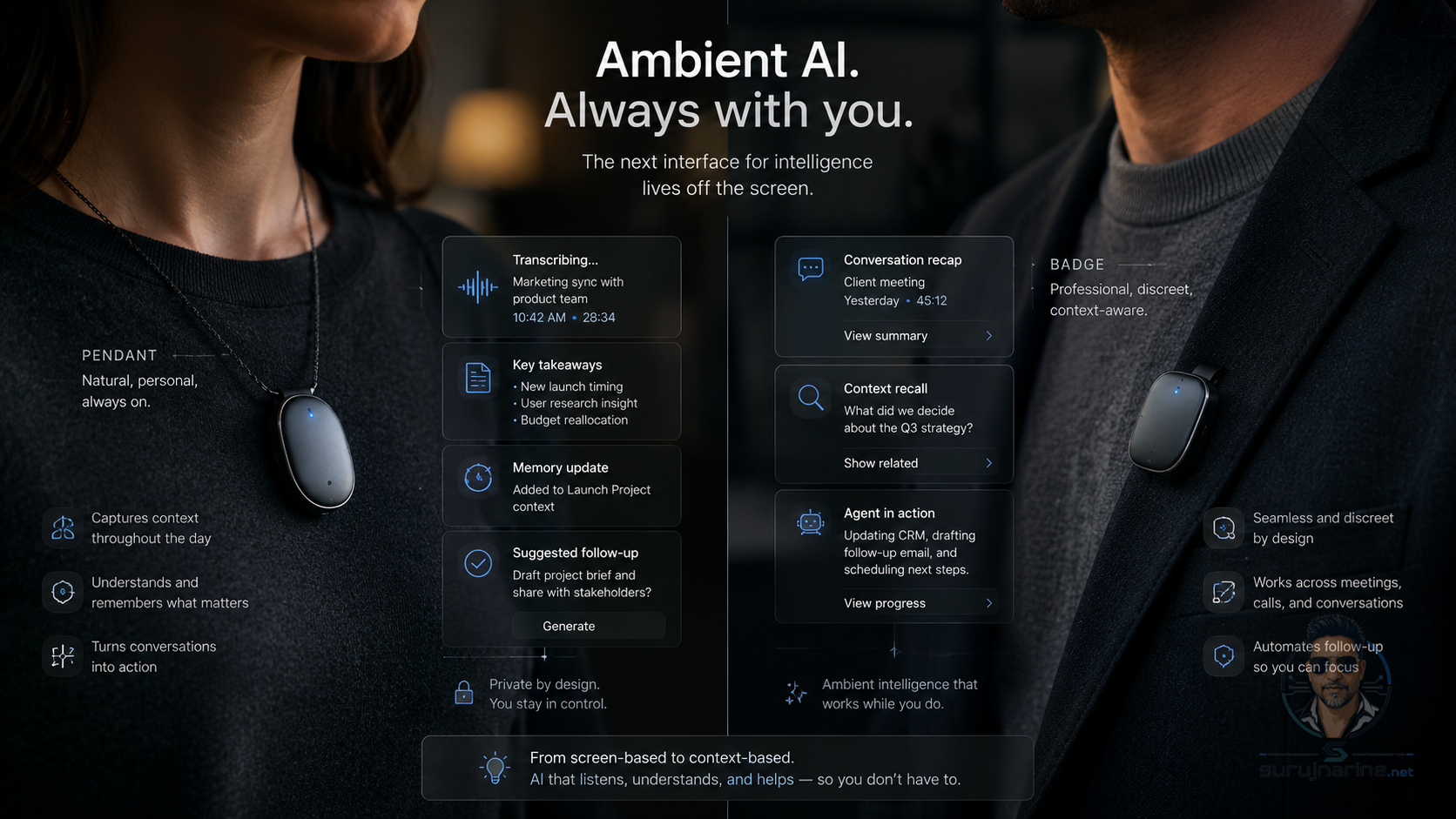
For years, a lot of us have interacted with AI through a familiar interface: a screen, a keyboard, a prompt box, and maybe a microphone button.
That may not be the dominant interface for much longer.
Meta is reportedly testing an AI pendant for work-focused wearables, while Microsoft recently showed a badge-style AI concept as part of Project Solara, its agent-first platform for new device form factors. Microsoft's badge concept points toward a world where enterprise devices can capture context, authenticate users, and route work through agents instead of traditional apps.
On the surface, these look like hardware experiments.
Underneath, they point to something bigger: the interface for AI may be moving off the screen and onto the body.
We have been inching toward this
This idea has been sitting in the background for years.
A friend of mine, Rich Washburn, and I have been talking about this exact direction for a long time: that the long-term interface for AI would likely become something more discreet, ambient, and wearable.
Not necessarily glasses.
Not always a phone.
Not a laptop.
Something you wear.
Something that stays with you. Something that captures context continuously or near-continuously. Something that turns lived experience into structured memory and actionable follow-up.
In our own way, Rich and I have already been experimenting with a rough version of that.
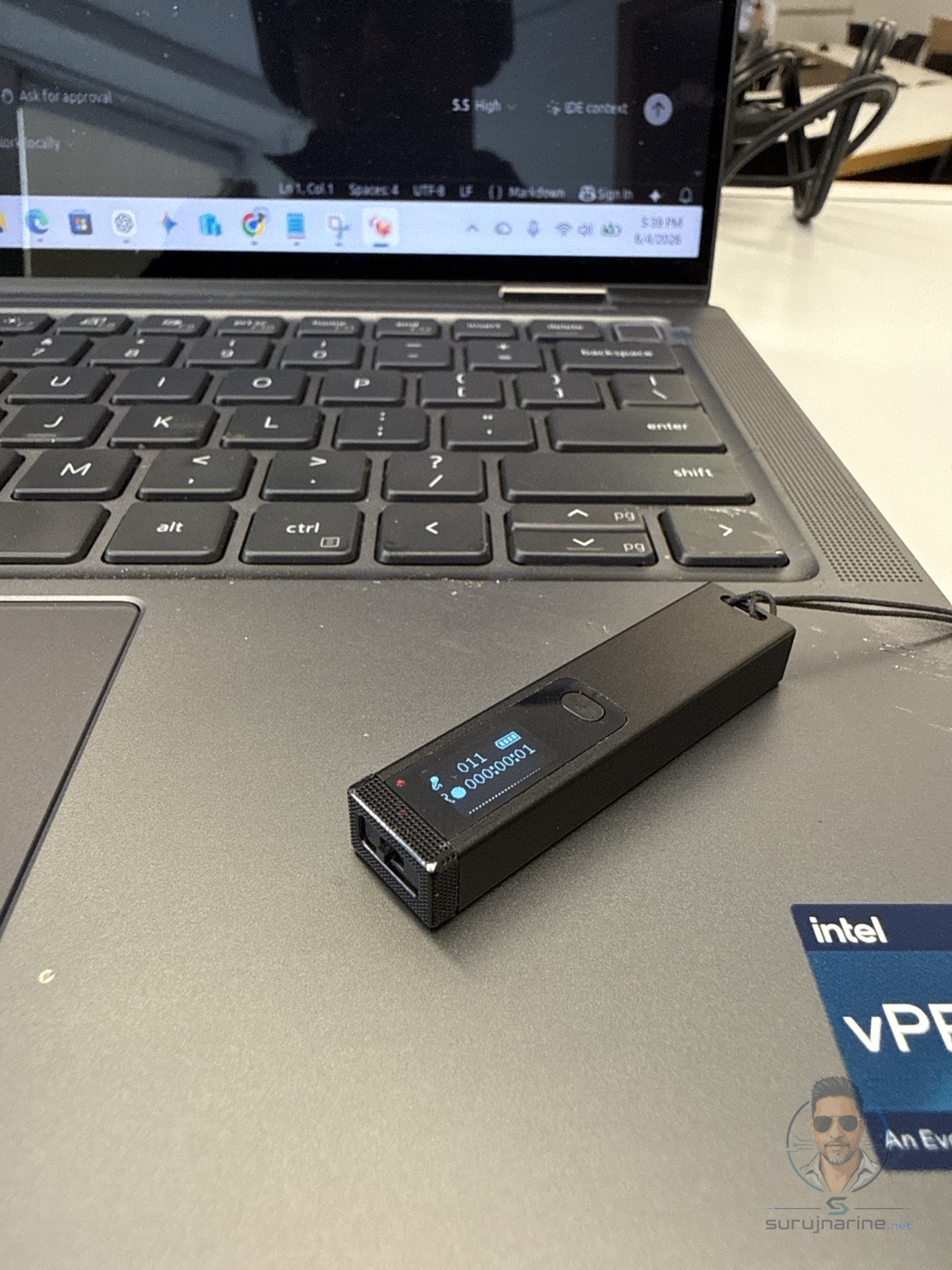
Using a small portable recorder, we have been doing the same basic thing with more manual steps:
- record the conversation
- transcribe it with Whisper
- send the transcript into an AI model
- extract insights, reminders, summaries, and follow-up actions
That workflow is clunkier than what Meta and Microsoft appear to be moving toward, but conceptually it is the same pattern.
The difference is that major platforms are now trying to collapse those manual steps into a more seamless wearable experience.
The interface shift matters more than the device
It is easy to get distracted by the hardware form factor.
Pendant versus badge. Camera versus microphone. Clip-on versus something around your neck.
But the deeper story is the UI shift.
For decades, computing has largely required us to stop what we are doing and move into the machine's interface. We sit down at the desktop. We take out the phone. We open the app. We type the query.
Wearable AI suggests something closer to the opposite.
The machine starts to move with you.
It becomes:
- more ambient
- more persistent
- more context-aware
- more integrated into your day
- more useful because it has more situational memory
That changes the nature of the interaction.
Instead of asking AI to help with isolated tasks, you begin creating the possibility of AI that understands the flow of your day, your conversations, your commitments, your unfinished loops, and your immediate context.
That is a very different interface paradigm.
From prompts to passive capture
The current AI experience is still heavily prompt-driven.
You think of something. You open a tool. You ask the question. You wait for the output.
That model works, but it still depends on explicit user initiation.
A wearable shifts the model toward passive capture and delayed intelligence.
The flow starts to look more like this:
- capture signals during the day
- convert them into structured data
- run transcription, summarization, classification, and extraction
- identify commitments, ideas, questions, follow-ups, and patterns
- return useful actions or memories at the right time
That is much closer to an AI memory layer than a chatbot interface.
Once you see it that way, the wearable becomes less interesting as a gadget and more interesting as a persistent context collector.
That is where the opportunity is.
This is where agents get interesting
If the raw input is continuous speech, environmental context, or captured experience, the real value is not just in the transcript.
It is in the system that acts on the transcript.
That is an agent problem.
A useful architecture could look something like this:
- a wearable or recorder captures the day
- speech gets transcribed with Whisper or another speech model
- an agent classifies and structures the material
- tasks, notes, questions, and action items are extracted
- the system routes outputs into workflows, reminders, knowledge bases, or follow-up prompts
That is where the jump happens: from AI heard something to AI helped me do something.
And that is where I think the conversation gets much more practical.
The hardware is only the front end.
The real value comes from the pipeline behind it:
- transcription
- memory
- retrieval
- summarization
- prioritization
- workflow integration
- human review
That is not just a wearable story.
That is an operating model story.
The enterprise implications are bigger than they look
It is easy to imagine consumer use cases first:
- remembering conversations
- capturing ideas
- creating to-do lists
- summarizing meetings
- building a searchable memory
But the enterprise implications may be even more significant.
If AI wearables become viable, organizations will eventually ask questions like:
- Can this reduce knowledge loss?
- Can this improve field work, service work, inspections, or healthcare workflows?
- Can it create better follow-up discipline?
- Can it support sales, project delivery, consulting, or operations?
- Can it capture institutional memory in a more usable way?
Those are serious questions.
But so are the risks.
Microsoft's Solara concept already points to enterprise-grade management, security, and privacy as part of the platform story. That is a signal that this category cannot succeed without control, governance, and trust.
Because the moment AI becomes something you wear all day, the privacy and consent questions get much harder.
The trust problem is real
This is the other half of the story, and it cannot be hand-waved away.
An always-listening or always-available wearable raises immediate concerns:
- Who knows it is recording?
- What gets stored?
- What gets transcribed?
- Who has access?
- How long is it retained?
- What is used for training?
- How is sensitive information filtered?
- What happens in regulated environments?
Those questions are not peripheral.
They are central.
The more ambient the interface becomes, the more invisible the data collection can feel. That may make the experience smoother, but it also raises the stakes for trust, consent, and visible boundaries.
This category will not be defined only by capability.
It will be defined by whether people are comfortable living around it.
What changes when AI is wearable
I think the biggest shift is this:
AI stops being a destination and starts becoming a layer.
You do not go use AI.
AI becomes part of the background fabric of the day.
That means the UI changes from:
- screen-first
- app-first
- prompt-first
to something more like:
- context-first
- capture-first
- memory-first
- action-first
That is a major change in how humans relate to software.
It may end up being more important than many of the model announcements that dominate the headlines. If AI becomes easier to access, easier to carry, and more naturally integrated into daily life, the barrier between experience and computation gets thinner.
That is where this starts to feel like a real platform shift.
My takeaway
Meta's reported pendant and Microsoft's badge concept are not interesting only because they are new wearables.
They are interesting because they point to a new interface for AI.
The next home for AI may not be your laptop, your phone, or even your browser tab. It may be something discreet that you wear.
Something that captures context.
Something that remembers.
Something that helps turn the day into structured follow-up, searchable memory, and useful action.
Rich and I have been thinking about this for years, and in our own manual way, we have already been experimenting with the pattern:
Record, transcribe, analyze, act.
What the big platforms are doing now is trying to compress that pattern into a more seamless product.
That has implications not just for personal productivity, but for enterprise workflows, agent design, memory systems, privacy, and the future UI of AI itself.
That is why this category is worth watching.
References
Related reading
The Hidden Cost of AI: Cognitive Offloading
AI can accelerate thinking or quietly replace it — on cognitive offloading, critical thinking, and habits worth defending.
AI Agents Need Managers Too
Why project management, agile delivery, and operating discipline become more important as AI agents enter real workflows.