
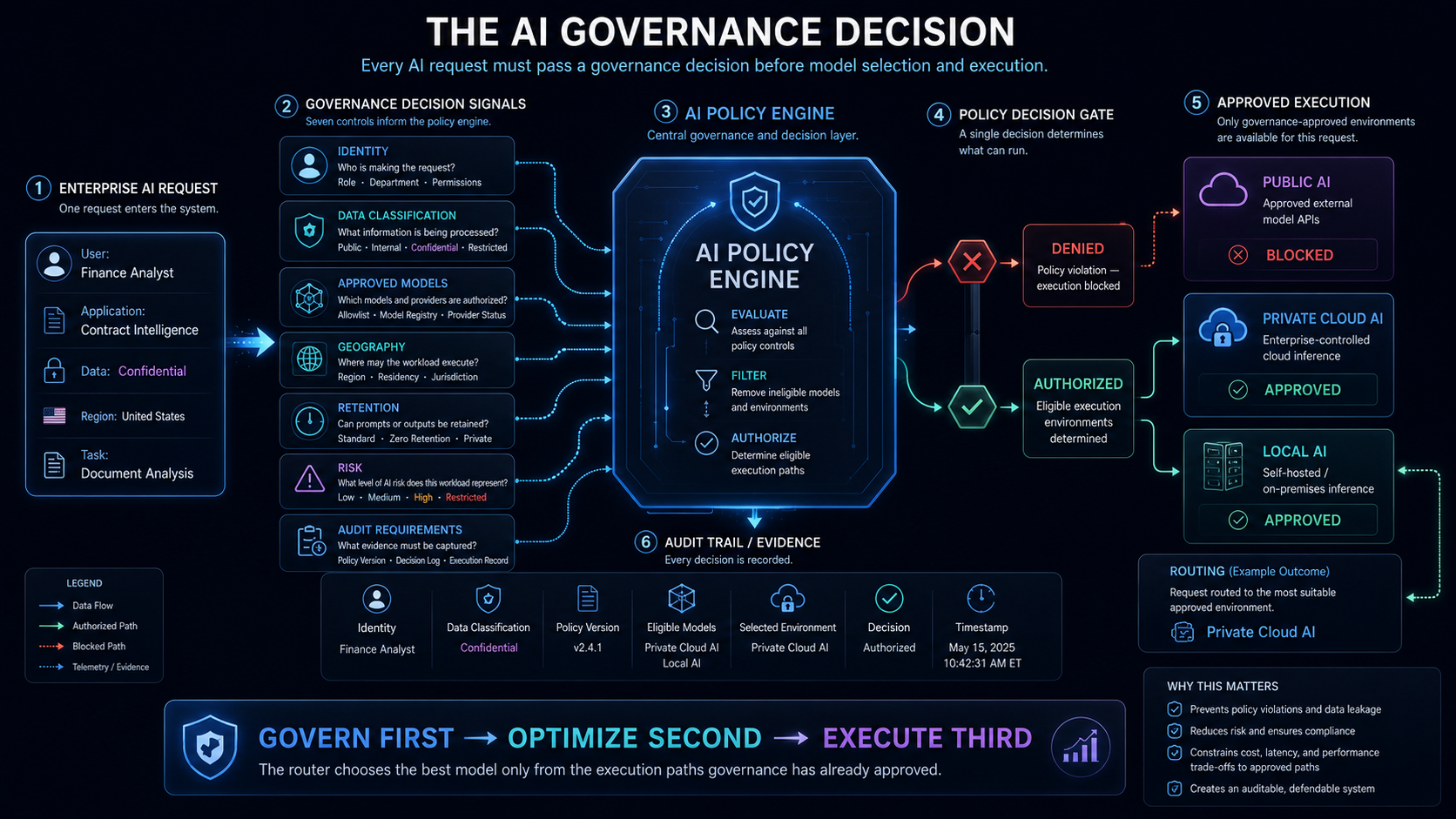
Multi-model AI gives enterprises flexibility. It also creates a new control problem: deciding which models, providers, and execution environments are allowed to process which data—and being able to prove why.
Article 1 in this series made the architectural argument for multi-model AI.
Article 2 made the economic argument for right-sizing intelligence.
Now comes the governance problem.
If an enterprise can dynamically route a request across public models, managed cloud models, and locally hosted inference, then every request becomes more than a model-selection decision.
It becomes a policy decision.
Who is making the request?
What data does it contain?
Which providers are approved?
Can the data leave the organization? Can it leave the region?
May the provider retain the prompt?
Can the request be logged?
Which model is permitted for this business unit?
Does the workload require human review?
And six months from now, can the organization explain why that specific request was routed to that specific model?
That is the AI governance gap.
The architecture became dynamic before governance did
For the first phase of enterprise generative AI, governance was comparatively simple.
An organization might approve one provider. Developers knew which endpoint to call. Security reviewed the data-processing terms. Procurement approved the contract. Legal signed off.
The architecture was static enough that governance could be static too.
Multi-model AI breaks that assumption.
A single enterprise application may now be capable of routing among:
- frontier public models;
- cloud-hosted partner models;
- smaller inexpensive models;
- specialist coding models;
- regional endpoints;
- zero-retention providers;
- private-cloud deployments;
- self-hosted open models.
The routing decision might change from one request to the next.
That means governance can no longer live only in an architecture-review document.
It has to participate in the request path.
Microsoft's current guidance reflects exactly this shift. Azure Policy provides built-in definitions that can restrict Foundry deployments to approved model identifiers and publishers, while Model Router honors those controls when determining which models developers can include.
That is an important clue about where enterprise AI architecture is headed:
Governance is becoming executable.
The model-selection problem is really a data-routing problem
At first glance, multi-model routing sounds like a performance problem.
Which model is smartest? Which is fastest? Which is cheapest?
But once enterprise data enters the request, the more important question often becomes:
Where is this data allowed to go?
Consider three prompts.
Prompt A
Rewrite this public marketing copy in a more concise tone.
Almost any approved external model may be acceptable.
Prompt B
Summarize these internal support tickets containing customer names and contact information.
Now data-handling policy matters.
Prompt C
Analyze these acquisition documents containing board materials, employee data, financial projections, and unreleased strategy.
The answer may be: this request cannot leave a controlled environment at all.
The task may be identical in form—summarization.
The governance outcome is completely different.
That is why AI routing should start with data classification, not model preference.
Privacy settings are becoming routing controls
The model platforms themselves are moving in this direction.
OpenRouter workspace guardrails can enforce model and provider allowlists, spending limits, zero-data-retention requirements, prompt-injection controls, and PII redaction. Zero-data-retention rules can be enforced by model group through guardrails or on individual requests.
Amazon Bedrock gives customers explicit control over prompt and output retention at account or project scope and can block requests when a model's requirements conflict with the configured mode. Separately, Bedrock model invocation logging can send supported runtime request, response, and metadata records to CloudWatch Logs or S3 when enabled.
Google's Gemini Enterprise Agent Platform documents the actions required for zero data retention, including how abuse monitoring, grounding features, request-response logging, session resumption, and caching affect retention.
These implementation details are different.
The architectural pattern is not.
Data-handling rules are moving into the execution path.
That matters because the enterprise should not depend on every developer remembering which model has which retention policy.
The platform should know.
The approved-model list becomes a security control
Enterprises already maintain approved software lists, SaaS vendors, cloud services, and data processors.
AI needs the same concept.
An enterprise model registry should not merely contain model name, provider, context window, and cost.
It should also contain governance metadata:
- approval status;
- permitted data classifications;
- allowed business units;
- geographic restrictions;
- retention and training-use policy;
- security review status;
- legal terms;
- supported and prohibited use cases;
- required human-review level;
- effective and retirement dates.
Now model selection becomes policy-aware.
A router could ask:
TASK: document summarization
DATA CLASSIFICATION: confidential
USER: corporate development
REGION: US
RETENTION: zero required
HUMAN REVIEW: required
And the eligible model set may shrink automatically.
That is governance operating as architecture.
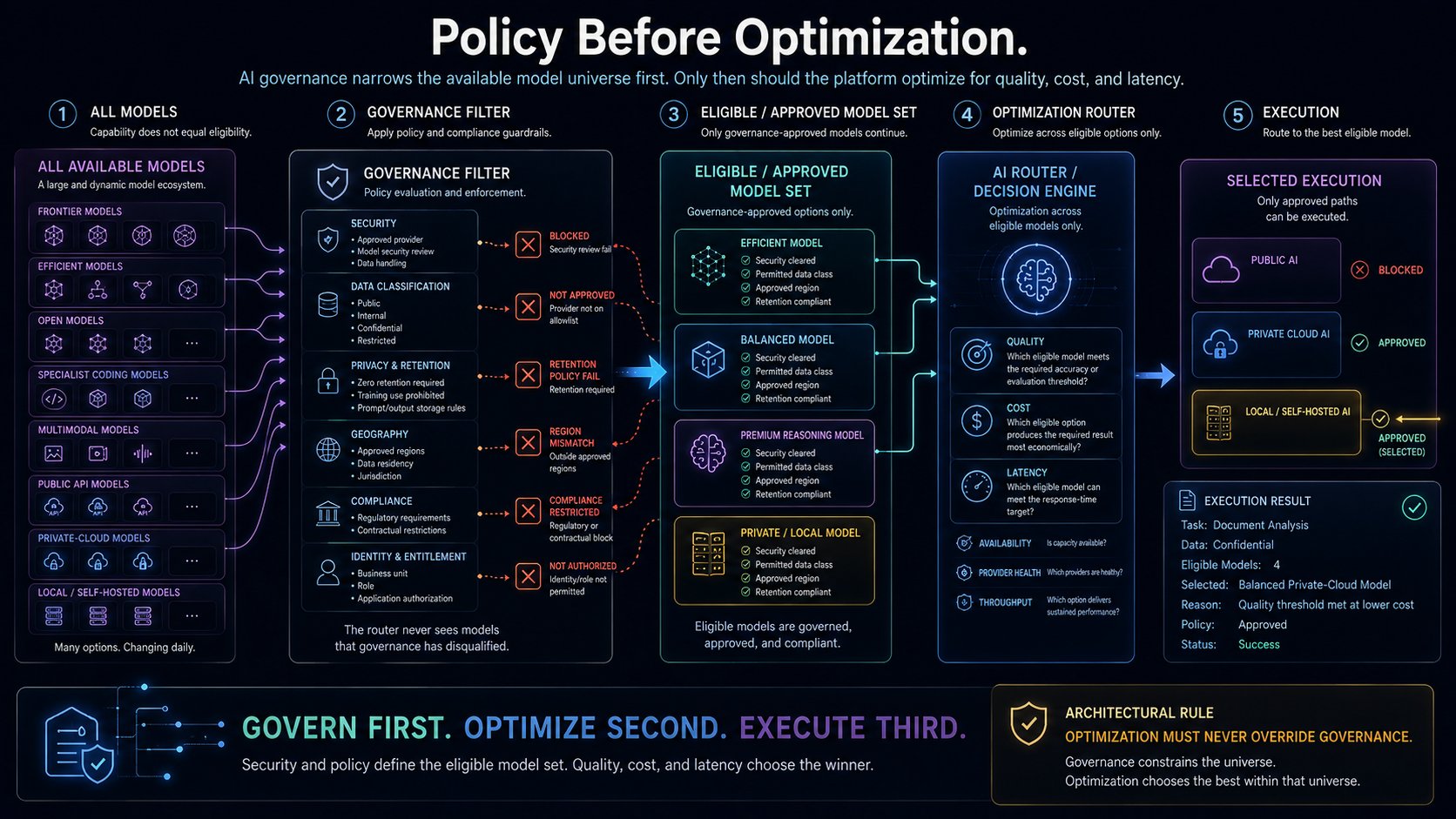
Security should constrain the model catalog before routing begins
A model router should not decide among every model available in the market.
It should decide among models the organization has already determined are eligible for the request.
The sequence should be:
REQUEST
   |
   v
IDENTITY
   |
   v
DATA CLASSIFICATION
   |
   v
POLICY FILTER
   |
   v
ELIGIBLE MODEL SET
   |
   v
COST / QUALITY / LATENCY ROUTING
   |
   v
EXECUTION
Security and governance act before optimization.
The system first asks:
What are we allowed to use?
Only then does it ask:
Which allowed option is best?
That distinction is critical.
Otherwise, the cheapest or fastest model may win a routing decision that should never have been available to it.
Identity belongs in the routing decision
Data classification alone is not enough.
Two users may submit identical prompts and receive different routing outcomes because their identities and roles differ.
A software engineer might be allowed to use a coding model with repository context. A contractor may not.
An HR employee may be allowed to process employee data inside an approved private environment. A general business user may be prevented from sending that same data anywhere.
An incident responder may temporarily receive access to a specialized cyber model that would otherwise be restricted.
This is familiar territory for enterprise security.
We already do this with IAM, RBAC, ABAC, conditional access, and privileged access management.
AI should not invent a parallel universe.
The same identity principles should govern access to models, tools, data sources, and agent capabilities.
Microsoft's agent trust and traceability guidance frames governance around auditable operations, clear data handling, security, compliance, transparency, and accountability.
The implication is straightforward:
AI authorization should be contextual, not universal.
The model is only one part of the trust boundary
There is another reason governance gets complicated quickly.
Enterprise AI requests increasingly touch more than a model.
An agent may:
- query a database;
- retrieve documents;
- call an API;
- use a browser;
- invoke code;
- send email;
- update a CRM;
- create a ticket;
- trigger another agent.
The true policy question is no longer:
Which model may see this data?
It is:
Which model, with which tools, acting as which identity, may access which data and perform which actions?
This is why agent governance will eventually merge with identity and access management.
A model may be approved. A tool may be approved. A dataset may be approved.
Yet the combination may still be too risky.
For example:
Approved model
+ Approved CRM connector
+ Approved customer dataset
+ Permission to send outbound email
= A workflow that may require additional review
Governance therefore has to reason about composition, not just components.
Auditability is the hidden requirement
Dynamic routing introduces another problem:
Explainability after the fact.
Suppose a regulator, internal auditor, customer, or legal team asks:
Why did this customer document get sent to Provider B on March 14?
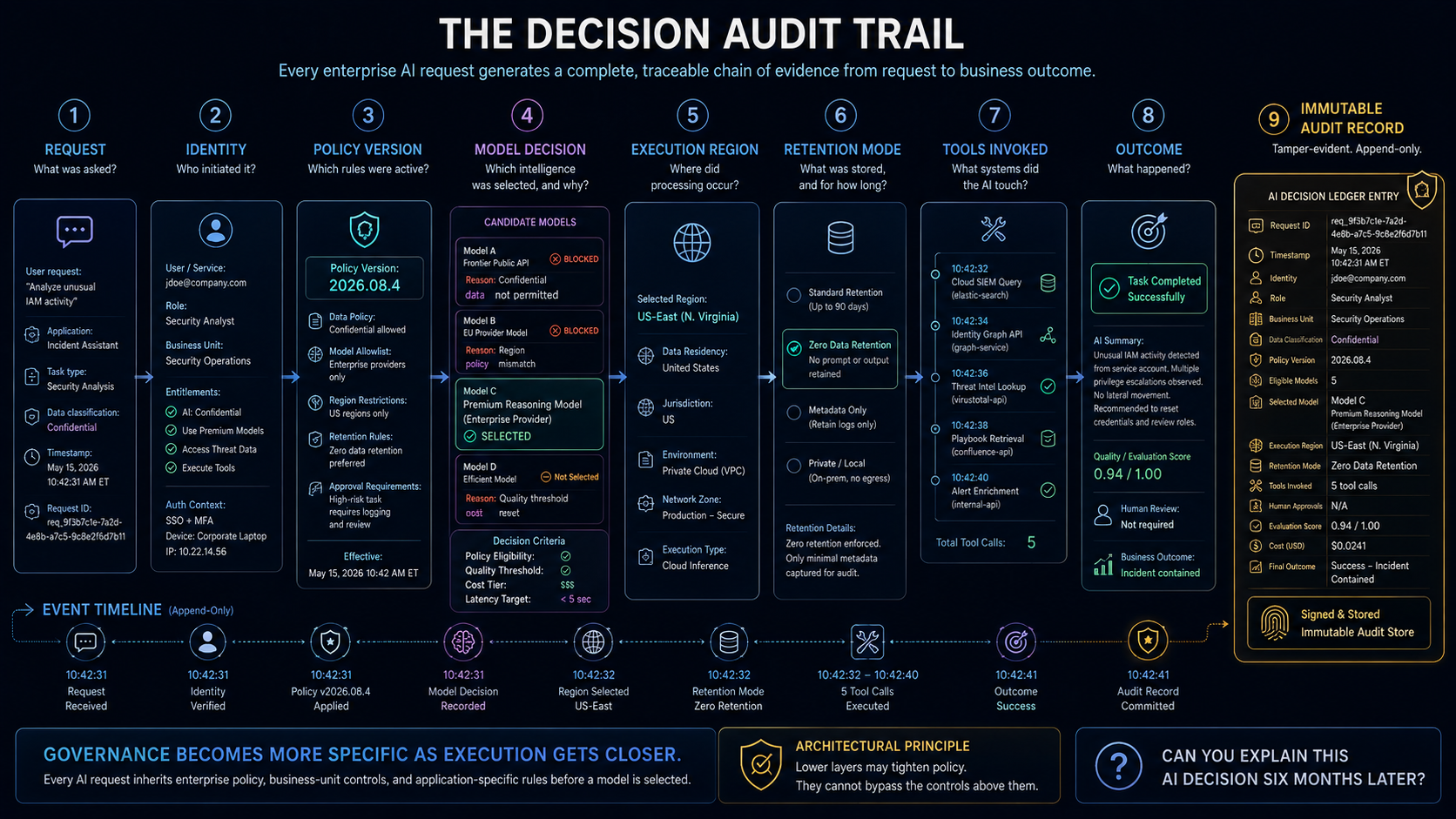
A defensible system should be able to answer:
- who initiated the request;
- which application made it;
- what data classification applied;
- which routing policy version was active;
- which models were eligible;
- which model and provider were selected, and why;
- where execution occurred;
- whether the request was retained;
- what tools were invoked;
- what human approvals existed;
- what output was returned.
That is not conventional application logging.
That is a decision audit trail.
Bedrock model invocation logging can capture supported runtime invocation metadata plus request and response data in CloudWatch Logs and S3, while CloudTrail records Bedrock API activity. Microsoft similarly treats continuous monitoring, traceability, and policy review as part of agent governance.
The control plane should therefore log not only what happened.
It should log why the platform allowed it to happen.
Governance needs versioning
This is a detail that becomes important surprisingly quickly.
Policies change.
A provider updates its retention terms. A new model gets approved. A regulator imposes a regional requirement. Security downgrades a vendor. Legal changes what data can be processed externally. A business unit receives an exception.
If the policy engine is dynamic, every decision should be tied to the policy version in effect at the time.
Otherwise, an audit six months later may see today's policy rather than the policy that governed the original decision.
This is the same reason infrastructure-as-code and configuration management value version history.
AI policy should be treated as code too.
policy_version: 2026.08.4
data_classification: restricted
allowed_execution:
  - private-cloud-us
  - local-inference
public_provider_access: denied
retention: zero
logging: metadata-only
human_approval: required
Now governance is reproducible.
Geography is becoming part of model selection
For multinational organizations, region matters.
An enterprise may have legal or contractual requirements that certain data remain within specified jurisdictions.
Azure Policy initiatives can restrict or audit service deployment regions, and Google Assured Workloads can enforce specified locations for regulated environments.
This adds another dimension to routing:
Best model globally
        !=
Best model legally available for this workload
That difference will matter more as AI becomes embedded into regulated processes.
Private connectivity is part of governance too
Data governance is not only about contractual handling.
It is also about network path.
AWS supports private access to Bedrock through AWS PrivateLink, allowing applications in a VPC to reach supported Bedrock endpoints without sending traffic over the public internet.
Two requests may use the same model family. But one travels through a public endpoint, while the other stays on a governed private network path.
Governance may prefer one even if the model itself is identical.
Again:
Model governance is really execution governance.
Guardrails are necessary, but they are not governance
The industry uses the word guardrails constantly.
They matter.
Amazon Bedrock Guardrails can evaluate prompts and responses against configured controls, including detection, masking, or blocking of sensitive information. OpenRouter guardrails can enforce provider and model restrictions, zero-retention requirements, PII handling, and prompt-injection controls.
But guardrails solve only part of the governance problem.
A content filter may prevent PII from reaching a model.
It does not answer:
- Who approved that model?
- Why was it eligible?
- Which contract governs the request?
- Which region processed the data?
- Was the response retained?
- What business unit paid for it?
- What policy version applied?
- Who approved the exception?
Governance is broader than filtering.
It is the system of decision rights, constraints, evidence, accountability, and review around AI execution.
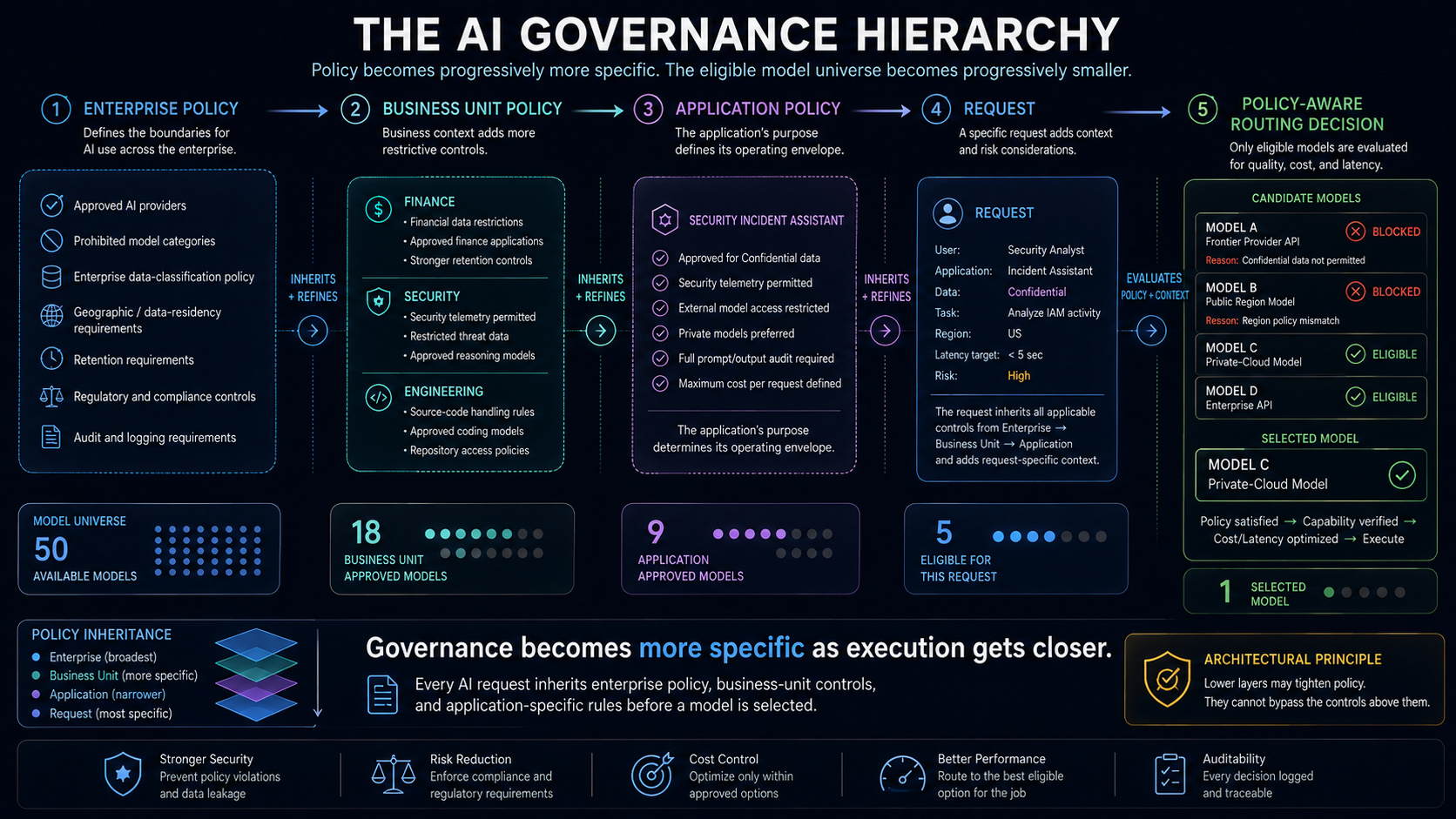
The governance hierarchy should look familiar
I think mature enterprise AI governance will eventually resemble other enterprise control systems.
At the top is enterprise policy: What categories of AI use are permitted? What data may be processed? Which external providers are acceptable? What requires private inference?
Then business-unit policy: What applications are approved? What budgets apply? What risk tolerance exists?
Then application policy: Which models can this system use? Which tools can it invoke? What quality thresholds apply?
Then request-level policy: What does this specific request contain? Which execution paths are eligible right now?
That gives us a hierarchy like:
ENTERPRISE POLICY
      |
      v
BUSINESS UNIT POLICY
      |
      v
APPLICATION POLICY
      |
      v
REQUEST POLICY
      |
      v
ROUTING DECISION
The decision engine inherits constraints from every level.
Exceptions are where governance gets real
Every governance framework looks clean until someone says: we need an exception.
And enterprises always do.
A security team may need to send attack artifacts to a model that ordinary employees cannot access. A legal team may need temporary access to a specialist provider. A development team may need to evaluate a newly released model.
The wrong approach is informal bypass.
The better approach is an explicit exception workflow:
REQUEST EXCEPTION
      |
      v
Business justification
      |
      v
Security review
      |
      v
Data scope
      |
      v
Expiration time
      |
      v
Named approver
      |
      v
Logged temporary policy
Exceptions should be narrow, time-bound, attributable, auditable, and automatically expired.
This is familiar governance practice.
AI simply needs to inherit it.
Shadow AI is really shadow routing
The rise of employee AI tools is often discussed as “Shadow AI.”
That framing is useful, but the architectural problem is broader.
Employees are effectively making routing decisions themselves.
They decide which model gets the prompt, which provider gets the data, which browser extension gets repository access, which chatbot sees customer information, which AI note taker hears a meeting, and which coding assistant reads proprietary source code.
Every unauthorized AI tool is an unmanaged routing layer.
Seen this way, the solution is not merely blocking AI.
It is providing a sanctioned path that is easier and more capable than the unsanctioned one.
An enterprise AI gateway can give users access to multiple approved models without requiring them to establish direct relationships with every provider.
That is not just convenience.
It is governance consolidation.
The control plane becomes the policy enforcement point
This brings us back to the architectural theme of the series.
Article 1 argued:
The model becomes an execution resource. The control plane becomes the strategic layer.
Article 3 adds:
The control plane also becomes the policy enforcement point.
A mature AI control plane may need to enforce:
- identity;
- data classification;
- model and provider allowlists;
- regional restrictions;
- retention requirements;
- cost ceilings;
- human approval;
- tool permissions;
- logging requirements;
- quality thresholds;
- fallback policy;
- exception policy.
Now the routing decision becomes:
Which approved model can legally, securely, economically, and operationally process this request?
That is far more sophisticated than asking which model is cheapest or which model scored highest.
Governance must precede autonomous routing
This matters even more as routing itself becomes AI-driven.
If an intelligent router is choosing among models dynamically, the router should not have authority to redefine the policy boundaries it operates within.
In other words:
The optimization layer should never be allowed to rewrite the governance layer.
A router may optimize cost, latency, quality, and availability—but only within a set of models already permitted by policy.
That separation is analogous to other enterprise systems.
A scheduler can optimize where a workload runs. It cannot decide to ignore security policy because another server is cheaper.
AI routing should work the same way.
The governance engine must be independent of the model
The same AI system being governed should not be the sole authority deciding whether its own behavior is permitted.
Policy should be external. Deterministic where possible. Versioned. Auditable. Independent of the model's reasoning.
An LLM may help classify the sensitivity of an ambiguous prompt.
But the final enforcement decision should come from a policy system the model cannot override.
Model proposes classification
            |
            v
Policy engine validates
            |
            v
Routing constraints applied
            |
            v
Request proceeds or stops
The model may participate in governance.
It should not own governance.
A practical enterprise routing policy
Imagine a company defines four data classes.
Public may use approved public APIs, private cloud, or local inference. Provider-default retention may be acceptable.
Internal may use approved enterprise providers, with zero retention preferred and request metadata logging required.
Confidential may use zero-data-retention endpoints, approved private-cloud environments, or local inference. Public providers require explicit approval.
Restricted may use only private cloud or local inference. Internet-hosted models are denied, and certain workflows require human review.
Now routing has a meaningful security boundary.
The model router does not invent these rules.
It enforces them.
What enterprises should start building now
You do not need a massive AI-control-plane project to begin.
Start with governance fundamentals.
Create an AI model registry
For every approved model, record:
- provider and security status;
- permitted regions and data classes;
- retention behavior;
- pricing tier;
- evaluation status;
- approval and review dates.
Define data-to-model policy
Make it explicit which data classifications may go to which execution environments.
Centralize access
Reduce direct provider keys scattered across applications and teams.
Log model decisions
Record not only which model responded, but which policy authorized the request.
Version policies
Every request should be traceable to the rules active at execution time.
Build an exception path
Do not force employees to invent their own workaround.
Review provider changes
Models, terms, security practices, and availability evolve rapidly. An approval should not last forever by default.
What I would measure
Governance also needs metrics:
- percentage of AI traffic going through governed gateways;
- percentage of requests with known data classification;
- percentage of calls using approved models;
- percentage of sensitive requests using zero-retention execution;
- percentage of regulated workloads executing in approved regions;
- policy violations blocked;
- time to approve legitimate exceptions;
- requests with complete decision audit trails.
These are much more useful than: “We published an AI policy.”
A policy document is not the same as a governed system.
The enterprise should be able to answer one question
Here is the test I would use.
Pick any AI request from six months ago.
Can your organization answer:
Who sent this data, to which model, through which provider, under which policy, in which region, with what retention terms, and why was that allowed?
If the answer requires asking three teams, searching Slack, looking through vendor invoices, reconstructing configuration, and hoping the developer remembers, then the organization does not have AI governance.
It has AI usage.
There is a difference.
My takeaway
Multi-model AI gives enterprises something valuable:
Choice.
But choice creates responsibility.
As the number of models, providers, execution environments, tools, and agents increases, governance cannot remain an annual policy exercise.
It has to become part of runtime architecture.
The policy system must determine who can use AI, which data can go where, which models are eligible, which providers are trusted, where execution may occur, whether retention is acceptable, which actions require review, and what evidence must be preserved.
Only then should the router optimize for capability, cost, latency, or availability.
That is the order that matters.
Govern first. Optimize second. Execute third.
The future enterprise AI platform will not simply answer:
Which model is best?
It will answer something much more important:
Which model is allowed to process this request—and can we prove why?
That is the governance layer multi-model AI now requires.
Next in the series
Article 4 — Building the Enterprise AI Control Plane
The first three articles established the case:
- multi-model architecture gives us choice;
- AI FinOps gives us economic discipline;
- governance gives us boundaries.
The final article will bring those pieces together technically:
Gateway → Identity → Policy Engine → Model Registry → Router
→ Evaluation → Telemetry → Audit → Provider Adapters
That is where we turn the concept into architecture.
References
- Microsoft: Built-in policies for model deployment
- Microsoft: Govern Model Router deployments with Azure Policy
- Microsoft: Determine trust, traceability, and transparency
- AWS: Amazon Bedrock data retention
- AWS: Model invocation logging
- AWS: Monitor Bedrock API calls with CloudTrail
- AWS: Bedrock Guardrails sensitive-information filters
- AWS: Private access to Amazon Bedrock
- OpenRouter: Guardrails
- OpenRouter: Zero Data Retention
- Google Cloud: Gemini Enterprise Agent Platform and zero data retention
Related reading
Beyond One Model: Why the Future of Enterprise AI Is Multi-Model
Enterprise AI is moving toward a multi-model architecture where a governed control plane routes each workload by capability, cost, security, latency, and policy.
Right-Sizing Intelligence: The New Economics of Enterprise AI
AI FinOps starts with matching model capability to workload demand and measuring cost per successful outcome—not merely tokens or cost per request.