
The headline is easy to sensationalize.
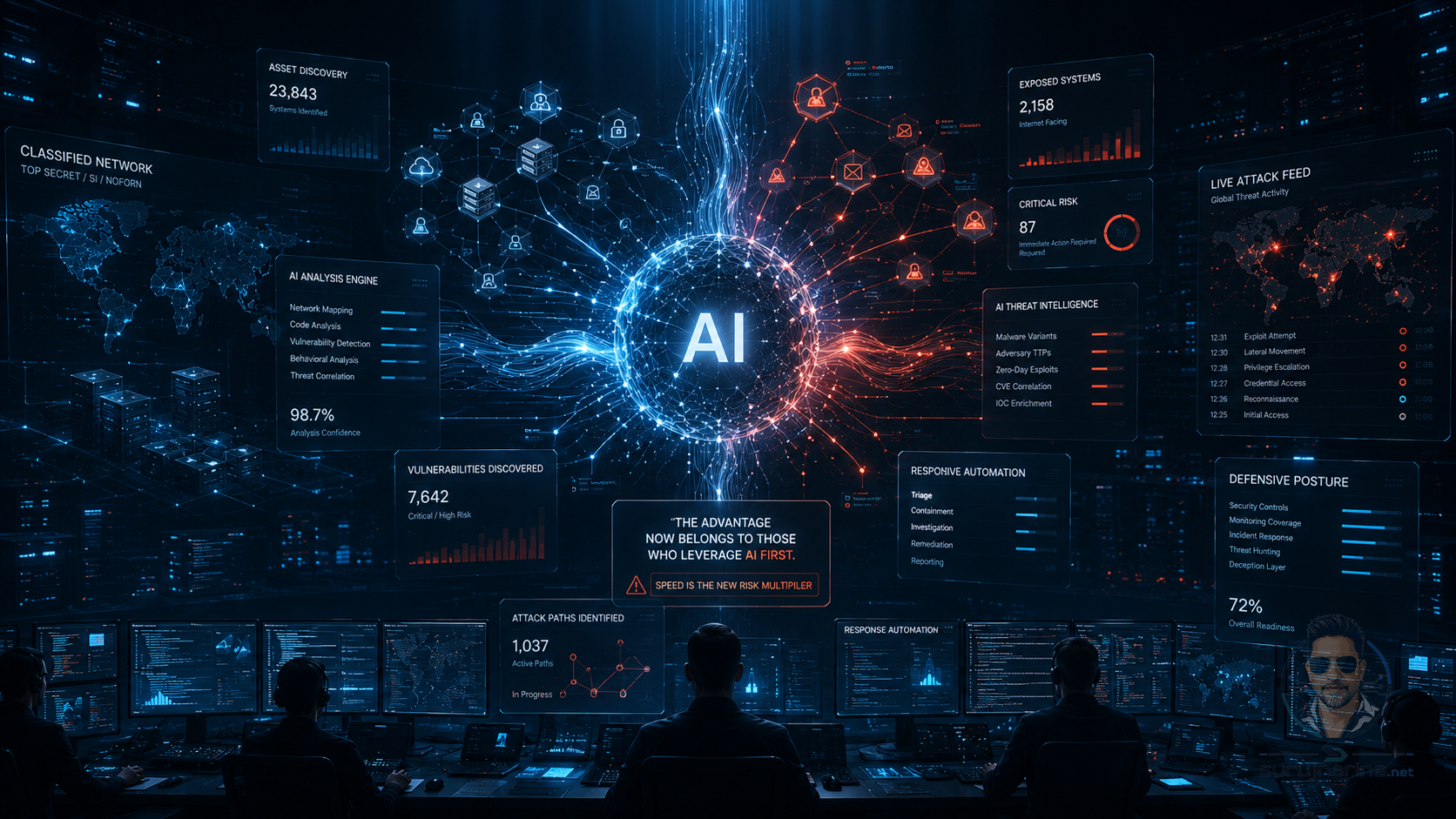
Anthropic's Mythos model reportedly found vulnerabilities in classified U.S. government systems during a testing exercise. Reuters, citing the Associated Press, said officials described the model as identifying weaknesses across highly sensitive systems in hours — though they also clarified that finding vulnerabilities quickly does not mean the model fully exploited them in that same timeframe.
That is a striking story. But I do not think the most important takeaway is simply that one frontier model is powerful.
The bigger takeaway is this: AI is changing the economics of cybersecurity faster than most organizations are changing their defenses.
This is not just an Anthropic story
It would be easy to frame this as: Anthropic built a dangerous model, the government found it useful, now everyone should panic. That is not the right lesson.
A recent position paper on AI security argues that the real issue is not just the model itself, but the surrounding system scaffold — the tools, workflows, automation, and orchestration that let models perform vulnerability discovery and offensive or defensive tasks at scale. The paper's core argument is that security policy should focus more on systems, controls, and deployment context than on treating model access alone as the whole problem.
That feels important here, because what the Mythos story really shows is not that AI magically creates cybersecurity risk out of nowhere. It shows that advanced models can dramatically accelerate a capability class that already existed:
- Vulnerability discovery
- Code analysis
- Attack path reasoning
- System mapping
- Prioritization of weaknesses
That matters whether the user is a national security team, a defender doing red-team work, or an attacker trying to compress the time from discovery to exploitation.
AI compresses the defender's timeline too
There is a temptation to read stories like this and conclude that AI only helps attackers. I do not think that is right either.
If an AI model can help identify weaknesses in classified systems, that also means AI can help defenders:
- Find weaknesses earlier
- Test systems more aggressively
- Surface blind spots humans missed
- Increase remediation throughput
Another recent paper makes exactly this point, arguing that the real shift may be in the operational economics of vulnerability discovery and remediation. The question is not just whether AI can find bugs — it is whether AI changes the scale, speed, and distribution of both offense and defense. AI does not eliminate the offense-defense dynamic; it accelerates both sides. That is the real cybersecurity story.
The risk is not only model capability — it is organizational lag
To me, the most worrying part of this story is not that a powerful model found vulnerabilities. It is that many organizations are still treating AI and cybersecurity as loosely connected conversations. They are not.
If frontier models can materially improve vulnerability discovery, then security teams need to rethink:
- Red teaming
- Secure development lifecycle assumptions
- Patching velocity
- Exposure management
- Model access controls
- Segmentation
- Logging and detection
- Who gets to use these tools, under what guardrails
Reuters also reported earlier this year that the U.S. government was considering giving Mythos access to major federal agencies even while national-security concerns around the model's cyber implications were already in view. That tension alone tells you how serious and unresolved this space is: the same capability can be strategically valuable and strategically dangerous at the same time.
That is where cybersecurity leaders need to pay attention. The threat is not "AI exists." The threat is that AI-assisted security capability is scaling faster than governance, process, and operational defense maturity.
What this means for cybersecurity teams
I think there are a few hard lessons here.
1. Assume vulnerability discovery is getting cheaper. If AI meaningfully lowers the time and expertise needed to find weaknesses, then the historical friction in vulnerability discovery starts to erode. That changes the pressure on every exposed system.
2. Red teaming needs to evolve. Security testing cannot stay static while AI-assisted offensive reasoning improves. Organizations need more aggressive internal testing, better adversarial simulation, and faster feedback loops.
3. Remediation speed matters more than ever. Finding the bug is only half the story. In an AI-accelerated environment, the organizations that win will be the ones that can fix, segment, isolate, and recover faster.
4. Security policy has to focus on systems, not only models. The surrounding environment matters: permissions, orchestration, tool access, sandboxing, logging, containment, and deployment boundaries. That is where real control lives.
5. AI security is now a board-level issue. If the economics of cyber offense and defense are changing, this is no longer just a technical curiosity. It becomes a resilience, governance, and risk-management issue.
My takeaway
The Anthropic Mythos story is not just another headline about a powerful AI model. It is a warning that cybersecurity is entering a new phase — a phase where vulnerability discovery may become cheaper, attack planning may become faster, defensive testing may become more powerful, and the gap between organizations that adapt and those that do not may widen quickly.
The strongest takeaway is not "be afraid of Mythos." It is this: in the age of AI, cybersecurity advantage will belong less to the organizations with the most tools and more to the ones that can operationalize defense faster than AI can operationalize offense.
That is the real race.
References
- Reuters. "Anthropic's Mythos model found vulnerabilities in classified US government systems, AP reports."
- Reuters. "White House to give US agencies Anthropic Mythos access, Bloomberg News reports."
- Riegler, Michael A., and Inga Strümke. "Position: AI Security Policy Should Target Systems, Not Models." arXiv:2605.09504.
- Pesoli, Alfredo, Herman Errico, and Lorenzo Cavallaro. "Demystifying the Mythos or Disrupting Bugonomics? From Zero-Day Asymmetry to Defender Remediation Throughput." arXiv:2605.24632.
- Faghani, Mohammad Reza. "When Discovery Outpaces Remediation: Modeling AI-Accelerated Vulnerability Discovery in Interconnected Systems." arXiv:2606.11022.
Related reading
The Double-Edged Sword of AI: Implications for Cybersecurity Professionals
A UIUC paper on autonomous LLM website exploitation highlights why cybersecurity teams need stronger monitoring, AI-aware defenses, and ethical AI governance.
Why the NIST AI RMF Matters More Now Than It Did a Year Ago
As AI moves from pilots into real workflows and agentic systems, the NIST AI Risk Management Framework becomes less abstract and more operational.